
Tag: greenland
US- Denmark Agreement Eases Tensions Over Greenland
by Erich Rumson ’28 on October 1, 2026
News - National & Global
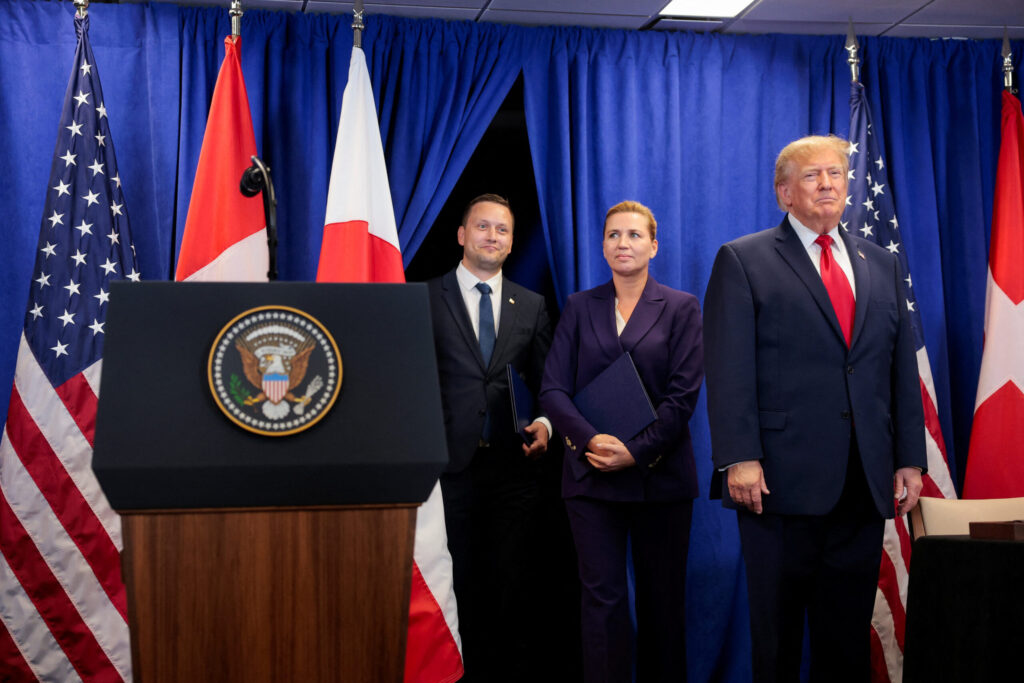
Last Tuesday, Sept. 22, President Donald Trump, along with leaders of Denmark and Greenland, signed a deal at the United Nations General Assembly in New York approving an increased U.S. military presence over the vast island in the North Atlantic. The deal also re-affirms Danish sovereignty over Greenland and acknowledges America’s important role in helping provide its security. The deal serves as a compromise following a long and heated dispute between the president and European allies over the island’s future, with Trump having openly stated throughout his second term his wish to make Greenland a U.S. territory.
Greenland, which has long been a territory of Denmark, is considered the world’s largest island, while also being one of the most sparsely populated, having under 56,000 people. Mostly covered in ice, only the southern parts of the territory are populated, and it has a fairly small economy, primarily centered on fishing. However, Greenland has long been seen as a strategic location for military bases, given its important position between North America and Europe. According to the BBC, the island’s location makes it an ideal spot for missile detection and monitoring vessels in the North Atlantic. Accordingly, the U.S. has maintained a military presence there since World War II. In a 1951 treaty, Denmark gave the U.S. military a lot of leeway in operating in the territory, and the American military presence there reached a peak during the Cold War. In more recent decades, the number of U.S. military personnel in Greenland has decreased, though Trump has sought to reverse this in his second term. Arguing that the island is crucial for U.S. defense against adversaries like Russia and China, Trump tried to pressure Denmark to give the U.S. possession of the island earlier this year, sparking a major controversy. Denmark refused any American offers to acquire Greenland, and polls taken in the territory show widespread opposition to U.S. control.
The deal signed last week serves as a halfway measure, reasserting both the need for a U.S. military presence to provide security and the island’s status as a Danish territory. It names two locations, Narsarsuaq and Mestersvig, as sites for future U.S. military bases. It also allows for the future construction of Trump’s proposed Golden Dome missile shield system, designed to protect the U.S. homeland from missile attacks. Along with giving broader permission for military installations, the deal also continues a practice of prohibiting non-NATO aligned countries from establishing any sort of military presence or financial influence on the island, while also outlining a joint American-Danish effort to prevent espionage from NATO adversaries. These measures are designed to address President Trump’s concerns over China and Russia gaining access to the island, which could undermine NATO security. The deal also has no end date, and would remain in place even if Greenland were to vote for independence from Denmark.
In his speech at the U.N. General Assembly last week, Trump discussed the deal, calling it an “unprecedented agreement, regarding… the large and strategically vital piece of land known as Greenland.” Going further, he said, “This agreement with the Kingdom of Denmark, incredible, beautiful country, and the Greenland people itself, gives the United States permanent control over security and all other needs of that territory.” According to the Wall Street Journal, the deal could pave the way for increased American investment on the island, which some Greenlanders hope could help grow its small economy, still very reliant on Danish subsidies. Regardless of its potential economic impacts, however, the deal could be a hopeful sign of improved relations between America and NATO allies like Denmark, which had been strained over the Greenland dispute.
Trump’s Plans for Greenland
by Molly Oldread ’26 on January 29, 2026
News
Within the past few days, President Donald Trump has forced the tiny Arctic island of Greenland into the center of the United States’ political spotlight. While the President has mentioned buying the island from Denmark before, his efforts have become significantly more concrete in the last few days.
On Jan. 17, Trump announced steep tariffs on many of the European nations that are allies with Greenland. These tariffs would impose a 10 percent raise on imported goods from eight different countries, including Denmark. Trump claimed these tariffs would start on Feb. 1 and rise to 25 percent by June if no deal between the countries could be agreed upon. Several of the countries threatened by these tariffs, including Norway, Sweden, France, Germany, the U.K., Finland, and the Netherlands, may have been targeted due to their actions in sending military troops to protect Greenland from a possible U.S. invasion.
Trump has continued to insist that the U.S.’ desire for Greenland is due to defense issues in relation to Russian and Chinese international political interests. Trump spoke at the World Economic Forum on Jan. 21, stating that the U.S. would not use military force in order to acquire Greenland, and that negotiations were crucial for the national security of the U.S.. He also spoke of his belief that the U.S. is in a unique position to defend the Arctic island and criticized European leaders who disagreed with his plans.
After discussions with NATO, Trump has rescinded his threats of tariffs on the European countries that have shown support for Greenland. Trump announced that the U.S. and NATO had formed the “framework of a future deal” with little to no detail. Trump continues to push for European cooperation, and for negotiations to continue over Greenland, despite the global criticism he has faced over the economic pressure he has threatened against various countries.