
Tag: primaries
2026 Primary Election Updates
by Victoria Miele ’28 on February 26, 2026
News
The United States holds primary elections every four years to determine which candidates from each political party will run in the general election. There are many types of primary elections, but the most common are open and closed. This being said, there are also semi-closed, blanket, top-two, and top-four.
In open primaries, citizens can vote for any candidate of any political party. This means a registered Democrat would be able to vote in a Republican primary. A voter is permitted to vote in only one party’s primary elections, but in many states, voters are not required to choose a particular political party when they register to vote.
In a closed primary election, voters are only able to vote for the candidate in the party with which they are registered. This means registered Republicans can only vote in the Republican primary election. In semi-closed primary elections, voters who are registered as independent or do not have a party affiliation are able to choose whichever party they want to vote for. However, those who are registered with a particular party are only able to vote for the candidate representing that party.
In 40 states the Democratic or Republican parties used an open, closed, or semi-closed primary in 2026. In seven states, the parties used a different type of primary, such as blanket, top-two, etc. In Alaska, California, and Washington, there were no partisan primaries for congressional and state-level offices.
As of February 2026, the Democratic Party used open primaries in 18 states, closed in 17, and semi-closed in 12. The Republican Party used open primaries in 15 states, closed in 23, and semi-closed in nine. For candidates to appear on the ballot, they must file paperwork with the proper entities by a particular time. The state with the earliest set time to file for the 2026 candidacy is Illinois in October 2025, and the latest time to file is in Delaware with a deadline of July 14, 2026. The 2026 general election will be held on Nov. 3. There will be legislative, congressional, gubernatorial, and statewide offices on the ballots.
Election of 2020: South Carolina Primaries and Super Tuesday Results
by The Cowl Editor on March 5, 2020
News
by Nicole Silverio ’22 and Kyle Burgess ’21
News Staff
Over the past several days, results from South Carolina’s primary elections and Super Tuesday have created major developments for the upcoming decision of choosing a Democratic nominee.
Earning 39 delegates and nearly 50 percent of the vote, former Vice President Joe Biden and his campaign celebrated a major win in South Carolina over the weekend, resetting the entire race.
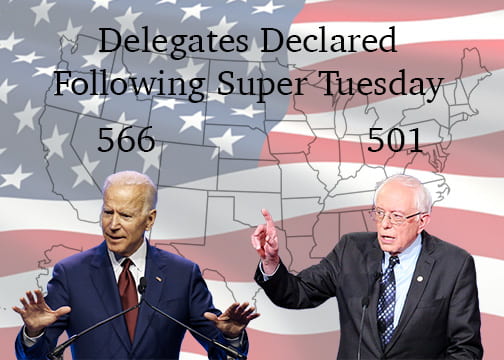
On Saturday, February 29, South Carolina held its Democratic presidential primary where Biden won a major victory, sparking hope for his campaign. Currently with 54 delegates, Biden was almost tied with Senator Bernie Sanders who had 58 delegates, threatening Sanders’ spot as frontrunner.
With 54 delegates at stake in South Carolina, Biden achieved immediate success by earning 20 delegates with only one percent of the vote being reported. Prior to South Carolina, Biden had only obtained 15 delegates after having minimal success in Iowa, New Hampshire, and Nevada, but the results in South Carolina had rescued his campaign.
Biden’s overwhelming support amongst black voters determined his victory, winning around three in five black voters. Two-thirds of voters over the age of 65 supported Biden.
With South Carolina’s large African- American population, Biden gained support for being Barack Obama’s vice president, who is beloved by a majority of black voters in the state. One resident of Columbia stated, “He was Obama’s vice president and he stuck by him.”
According to exit polls, 56 percent of the Democratic electorate was African American, adding to the significance of Biden’s support amongst black voters in the state. A Fox News voter analysis found that Biden is the highest rated Democratic candidate on who can best handle race issues, attaining 38 percent.
According to CNN, the favorable numbers amongst candidates in South Carolina overwhelmingly leaned towards Biden. According to the poll, 76 percent found Biden a favorable candidate with only 20 percent finding Biden to be unfavorable. Meanwhile only 53 percent favored Sanders, with the remaining 41 percent finding Sanders unfavorable. In regards to Mayor Michael Bloomberg, 26 percent of South Carolina voters found him to be favorable while 66 percent consider him unfavorable.
After Biden’s victory, other candidates began to lose hope in their presidential campaigns. That night, as Biden gave his victory speech, businessman Tom Steyer dropped out of the race. On the following day, Mayor Pete Buttigieg announced the end of his presidential bid. Senator Amy Klobuchar also dropped out of the race. Both Buttigieg and Klobuchar have following backed Biden since the results in South Carolina.
The former vice president’s success in the Palmetto State was mirrored across the South and elsewhere following the results of Super Tuesday. Biden carried Alabama, Arkansas, Maine, Minnesota, North Carolina, Oklahoma, Tennessee, Virginia, and was even able to upset Senator Elizabeth Warren in her native Massachusetts. Not to be outdone, Senator Bernie Sanders captured the biggest prize of the night in the California primaries, coupled with his victories in Colorado, Utah, and Vermont.
These most recent results have effectively made it a two-horse race for the Democratic presidential nomination between Biden and Sanders. Following his inability to “get it done” at the polls, former NYC Mayor Michael Bloomberg announced his withdrawal from the Democratic contest with Elizabeth Warren likely to follow suit. Such concessions would follow in the footsteps of billionaire Tom Steyer, Klobuchar, and Buttigieg.