
Tag: social media
Hannahversary: The 20th Anniversary of Hannah Montana
by Isabelle Camoin ’26 on April 16, 2026
A&E - Film & TV
The 20th anniversary of Hannah Montana was a celebrated television event that premiered on Disney+ and Hulu on March 24. My mom had mentioned that the special was going to be aired, as she knows how much I enjoyed watching Hannah Montana growing up. I did not know what to expect from an anniversary special of a show that is no longer being filmed, but I decided I might as well check it out.
The Hannah Montana 20th Anniversary Special featured an exclusive interview hosted by Alex Cooper, the host of Call Her Daddy podcast. During the special, Miley Cyrus takes credit for the special taking place, claiming it was her idea and not Disney’s. She simply announced on social media that the special was happening, which accumulated so much fan support there was no choice but to put on the show. This really draws our attention to how powerful popularity can be and how publicity can lead to action.
In a way, this method of garnering support is pretty on brand for Hannah Montana itself. The show depicted a once-fictitious audience, featuring staged performances with paid crowd actors who were supporting a fictitious pop star named Hannah Montana. Unlike a Seinfeld episode where Jerry featured clips from his live standup to introduce a fictitious show, Hannah Montana’s performances in the TV show were entirely fictional. This fictitious character now has real fans and real supporters. Eventually, there was a Hannah Montana tour, where Cyrus toured as Hannah Montana, singing the songs written for the show. Cyrus reminisces on these performances during the anniversary sharing, “It was me,” reclaiming her work and merging her private and public identity into one.
As I was watching, I found it peculiar that a fictional character became so real. Where else in life does this phenomenon happen? Cyrus also performed some of her so-called “Hannah” songs in order to depict her journey of reclaiming her now unified identity. She performed “This is the Life,” a Hannah Montana song that was performed during her time as an adolescent. In her attempt to reclaim her identity through performance, Cyrus performed this song in a more mature manner, in an elegant gown, with a single spotlight, less glitter, a slower tempo, and with a much deeper voice, signifying that the artist she once performed as no longer exists.
The special itself depicted Cyrus embracing her alter ego Hannah Montana, sort of like how Taylor Swift re-released albums to sell her versions. In fact, she even took credit for launching the career of Swift by giving her a platform in Hannah Montana: The Movie (2009). Throughout the special, Cyrus took credit for many things related to pop culture, including contemporary culture as it exists today. During her short time on air and reminiscing about their acting together, Selena Gomez remarked, “You created culture babe.”
The interview took place on the set of the show, and the audience was given a tour of Hannah Montana’s closet. This was a staple location during the filming of Hannah Montana; it was the place where the transitions happened. Cyrus would step into the closet and come out as her alter ego, pop star Hannah Montana. Throughout the special, Cyrus met with key people in her life. Each time passing on objects from the closet, signifying that she was letting go of the Hannah identity tied to the Disney show.
As I watched, I kept experiencing this cycle of beginning to feel emotional about the picture Cyrus was painting, but these moments were continually interrupted by advertisements. The special in its entirety was about an hour and a half, though about 30-minutes of it consisted of ads.
Not to mention, despite this overarching theme of identity and reality, Cooper seemed to barely scratch the surface. I thought this special was really going to get somewhere when it came to better understanding Cyrus and her relationship with Disney. To a degree, she reflected on how the show and the network shaped her development, especially by working with her dad on set as her on-screen father. However, Cooper was more concerned with asking about her outfits, her appearance, and her crushes than asking interesting, hard-hitting questions.
Writer’s Opinion: I find it hard to enjoy a sentimental TV special of this sort, and the drama of which Sprouse twin Cyrus was most attracted to at the age of 14, when the United States is currently facilitating the destruction of another country’s civilization.
I am not saying I expected Cyrus to be political by any means, but I expected this special to be a bit more meaningful rather than subliminal. Additionally, I think this special really draws our attention to how some art and pop culture chooses and are so far removed from our general society. I consumed this special without having to bat an eye at any deep retrospection of myself or the world around me. Which got me thinking: we are so worried about iPad kids, but it is our generation that was raised on pop culture and the external influence of curated fiction that is mass-produced and consumed.
Practicing Communication and Trust On Campus
by Sarah McLaughlin '23 on April 20, 2023
Editor-in-Chief
Editor's Column
A key part of what makes a community is building a bond of trust and communication. In general, the Providence College student body would agree that these things are important for fostering a healthy “Friar Family.” Many students have expressed concerns regarding the communication we receive regarding incidents that occur on campus. When students hear about on-campus incidents from rumors and social media prior to hearing from official sources—or in place of them entirely—we foster an environment of gossip, misinformation, and mistrust.
One example of students’ lack of knowledge is when fire alarms go off in dorm buildings. Often, these are fire drills, and at the beginning of the year, public safety officers meet with students outside to inform them of the safety and evacuation protocols. However, when the fire alarm goes off later on in the year, students are seemingly never informed of whether these instances are drills, someone pulling the alarm, or actual emergencies. “The fire alarm went off at 3 a.m. one night in Davis when it was below freezing, and we all had to evacuate, and we still have yet to learn why this happened,” one student recounted. This lack of information is what causes rumors to spread.
Regarding the incident which occurred off-campus on April 1, students received the information published by the College in an email, which reflects the press release The Cowl included in this week’s issue. This email was sent at 3:58 p.m., while the incident occurred in the morning, as this is when students noticed police activity on-campus. Students were not informed of what happened on-campus, only that an off-campus incident occurred, which fostered more confusion in an already confusing situation. Prior to finding out the name of the student involved by reading news articles, students took to social media to speculate. Names were thrown around which turned out to be completely incorrect. The fact that some students had to face these random accusations and gossip is the fault of both the students for jumping to conclusions instead of waiting for information and of the College for not sending timely updates on the situation.
One member of The Cowl’s editorial board spoke on the matter: “When it involves the safety of the Providence College community, we have the right to be informed of what’s going on. There’s not an efficient system and way of doing that—finding out hours after something happened is unacceptable.” The Cowl hopes we can speak on behalf of the student body when we say that we hope the College will consider our concerns.
Genius is in the Eye of the Beholder
by Meghan Mitchell '23 on February 9, 2023
Opinion Staff
Opinion
Elon Musk in recent years has become a very controversial figure in the public eye. Being the CEO of Tesla, SpaceX, and other companies, the man was hailed in the media as the real-life equivalent of Marvel’s Tony Stark. However, after a series of questionable business decisions, public opinion seems to be shifting to the fact that maybe, just maybe, Musk is not as intelligent as the media initially portrayed him to be. While it is true that Musk created Tesla, that does not mean he is a genius. Just because someone had a good idea and got lucky does not mean they are intelligent.
Even then, he isn’t the one who founded Tesla; Martin Eberhard was. Musk bought a stake in the company and allegedly kicked Eberhard out and took credit for his idea. SpaceX is funded and contracted by the government, so his involvement in the company isn’t as vital as people are led to believe.
Musk’s most recent questionable decision is his acquisition of Twitter. Once the company was in his possession, Musk proceeded to lay off most of the staff in order to save money. The problem with this decision is that he laid off so many people, the site started to suffer from outages and other issues. He ended up having to ask people to come back, saying they were “laid off by mistake.” Furthermore, according to The Guardian, more than 30 million users are expected to leave Twitter due to concerns relating to technical issues the platform has been experiencing since Musk’s ownership of the platform began and his slack stance on potentially offensive and harmful content.
To gain revenue from his purchase, Musk changed verification on the platform, so users now have to pay for it. Originally the price was $20 before it was lowered to $8, because nobody was willing to pay that much for a blue checkmark. This decision to have users pay to be verified was quickly abused by internet trolls who would masquerade as public figures or companies. One internet troll pretended to be a pharmaceutical company and tweeted that insulin was now free, causing the company’s stocks to plummet by 10 percent and costing them millions in revenue. This caused many companies to also pull back from Twitter, no longer trusting the website to host their ads and thus causing Twitter to lose ad revenue.
Going back even further, Musk’s lack of common sense was broadcasted to the world through his Twitter account during the COVID-19 pandemic. Not only in March 2020 did he call people who were worried about COVID-19 “dumb”, but he also spread false information about there being “quite a few negative reactions” from people who received a second COVID-19 booster. In addition, his false accusations about the COVID-19 boosters could cause serious damage, because he has great influence over his followers on social media. Musk has made countless other mistakes online, and has shown himself to not be a very good person to boot, but this piece isn’t about judging the morality of his character. This is about letting others know that he is not the genius he embodies in his public persona. When will the world realize that Elon Musk is not the real-life version of Tony Stark? Because in actuality, he’s just pretending to be.
The Question that Trumps All: A Grand Return to Twitter?
by Christina Charie '25 on November 3, 2022
Opinion Editor
Opinion
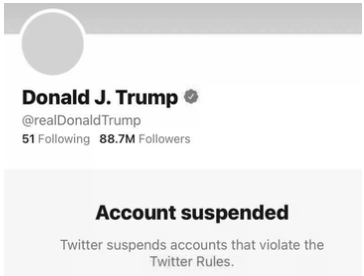
In the wake of Elon Musk’s Twitter takeover, America is left wondering if former President Trump will be allowed to return to the platform. Musk has alluded to this action throughout his negotiations with Twitter, which has Trump anxiously awaiting his grand return to the social media network. Now that the Tesla founder officially owns Twitter, Musk has reportedly fired staff members responsible for suspending Trump, which raises speculation surrounding the issue.
With midterm elections rapidly approaching, reinstating Trump’s Twitter account could have serious ramifications.
It is clear that the former president can mobilize large groups of people by claiming election results are fraudulent. Whether or not these claims are founded upon accurate evidence, Trump’s rhetoric influences large numbers of people to take unprecedented action. His tweets on Jan. 6, 2021, were a major catalyst for the riots on the Capitol that took place.
Trump’s return to Twitter could result in another Jan. 6 scenario. Two consecutive unpeaceful transitions of power after elections would further polarize the nation, making collaboration between parties out of reach.
The former President has been subpoenaed by Congress because of his actions on Jan. 6. Additionally, the subpoena specifically requests electronic communications related to Trump’s actions on that day. No president is above the law, but Trump would certainly use Twitter to convey otherwise. Musk would put members of the select committee in danger if he reinstates Trump’s Twitter account.
Recently, Steve Bannon, a former Trump administration member, has been sentenced to prison time for ignoring a Congressional subpoena. Former President Trump should face the same consequences if he chooses to ignore his subpoena. If Trump is allowed to tweet once again, his previous behavior indicates that he will continue to promote his agenda, even if it puts others in harm’s way.
While many, including Trump himself, argue that banning him from social media is a violation of the First Amendment’s freedom of speech clause, the right does not protect individuals who knowingly scream “fire” in a crowded public space. Metaphorically, this is exactly what the former president has done.
The recent attack on Paul Pelosi, the Speaker of the House’s husband, foreshadows the consequences of social media being used as a catalyst for polarization within American politics. Make no mistake, there is a clear reason why this occurred less than two weeks before the election.
Disagreement and debate are inherent features of any democracy. Attacking the Speaker’s immediate family member and fracturing his skull is not. Ultimately, the Constitution protects only non-violent protest and organization.
Trump’s consistent public shaming of particular politicians that disagree with his viewpoints, including Nancy Pelosi, makes them targets for violence and harassment. Upholding democratic checks and balances as outlined in the Constitution is not justification for violence, even if one disagrees with the course of action.
Donald Trump Jr.’s actions on social media in response are only perpetuating radicalization and political violence. The post, which can be found on Truth Social, is a picture of a hammer and a pair of underwear with the caption “Got my Paul Pelosi Halloween costume ready.” This response is incredibly insensitive given that Pelosi suffered from a fractured skull that required surgery. All acts of political violence should be taken seriously instead of utilized as a comedic opportunity.
By continuing to use social media in a toxic manner, the Trumps consistently prove that they are unwilling to change despite the horrific consequences.
No matter the party affiliation, everyone should hold officials accountable for their actions online by demanding a formal public apology from the Trumps. Ignoring these issues sets a dangerous precedent for future leaders while putting American democracy on an uncertain path. Like any other American that receives a subpoena, the public should expect former President Trump to cooperate with the investigation.
America cannot deliver justice unless all individuals are subject to the law, including those in power.