
Tag: Trump
Major News Outlets Face Threats to their First Amendment Rights: The White House’s Media Ban
by Victoria Miele ’28 on September 24, 2026
News
On Friday, Sept. 18, President Donald Trump threatened to bar reporters from certain news organizations because he found their reporting to be “fake news.” The next day, Saturday, Sept. 19, reporters from CNN, MS NOW, and Politico were all denied access to the White House.
MS NOW’s reporter, Akayla Gardner, stated that she was able to get through two gates successfully, but when she reached the area where she needed to scan her badge, her access was denied. The officer at the checkpoint told her that her badge was disabled and asked her to hand it over, stating that the decision was “above him.” Later, an MS NOW producer was able to get in, but a photographer’s badge was also disabled.
A senior White House Reporter for CNN, Betsy Klein, was met with a similar situation, being told that her badge had been deactivated and was then confiscated. The officer at the gate told her that if she needed any more information, she could go to the White House press office.
Klein and Gardner both went live on their respective news outlets to report that they had been turned away and their badges had been confiscated when they arrived for work at the White House. Soon after they aired, Politico made a statement saying one of their White House reporters, Cheyenne Haslett, was also denied entry and had her badge confiscated.
All three news outlets expressed frustration and hinted that they will consider taking legal action. Politico Editor-in-Chief Jonathan Greenberger said, “We will vigorously defend our First Amendment rights.” CNN published a statement saying the network “will not be deflected from our duty to hold the government and other public bodies to account.” Finally, MS NOW said they “intend to take any and all steps necessary to defend our First Amendment rights and the essential role of independent journalism in our democracy.”
President Trump wrote on his social media sites on Friday that, effective immediately, he would be banning media networks “from the White House as a result of their constant ‘reporting’ FAKE NEWS!”
Many news outlets found this to be increasingly concerning, and WHCA president, Jacqui Heinrich, called on the president and his administration to immediately restore White House access for CNN, MS NOW, and Politico. Heinrich said, “the implications extend beyond these organizations: a standard use to exclude one news outlet because of its coverage could be applied to any outlet in the future. The American people, through a free and independent press, must be able to scrutinize those elected to power, regardless of whether government officials view it favorably.”
AP News spoke out in support of the banned organizations stating, “No news organization—or person—should be retaliated against by the government over the words they use.” Now, we can only wait and see what will come next for these reporters and the implications this decision will have on American citizens all over the nation.
The Kennedy Center’s Last Act? Trump’s Naming Tantrum Crescendos Toward a Destructive Finale
by Charlie Hergott '27 on September 24, 2026
News
Last Wednesday, Sept. 16, President Donald Trump was photographed on Air Force One looking over a placard that appeared to read, “Kennedy Center DEMOLISHED” in large red letters. The photo was taken from outside the plane and captures Trump through a window examining the placard. Trump’s apparent envisaging of a demolished Kennedy Center is only the latest installment of his ongoing 19-month feud with the institution over its name.
Last December, outrage broke out when the board voted to add the president’s name to the Kennedy Center, thus making it “The Donald J. Trump and the John F. Kennedy Memorial Center for the Performing Arts.” Since then, President Trump has been engaging in a battle over the legality of adding his name to the center. His name remained on the building until June of this year, when a federal judge ruled that because the name of the Kennedy Center was established by a congressional act, it could only be altered by a congressional act. Nevertheless, the president has persisted and made attempts to have his name affixed to the building to recognize the work he has done to transform the Kennedy Center.
Ultimately, the feud over the institution’s name began with the president’s broader attempt to reshape and redefine the arts in the United States, striving to reach a Golden Age in Art and Culture. In February of last year, Trump became chair of the Center by firing half of the Board of Trustees and replacing them with partisan loyalists, who quickly voted him in as chair thereafter. President Trump was explicit in naming his reasons for the takeover: “I’m going to be chairman of it, and we’re going to make sure that it’s good and it’s not going to be woke. There’s no more woke in this country.” Soon thereafter, he fired the executive director and replaced him with a longtime loyalist, Richard Grenell, who has since cancelled a number of performances on this ground, including shows like Hamilton.
A number of artists have also refused to perform at the Center as an act of protest. The most recent development—Trump proposing the idea of destroying the Center completely—sparked a protest in which hundreds of activists formed a human chain around it. “The demonstration opposes the recent sudden closure of the facility, the installation of security fencing, and political efforts to alter or demolish portions of the presidential memorial,” The Hands Off the Arts organization stated on its website. A federal judge ruled that any major structural changes to the Kennedy Center must be announced at least 30 days in advance of executing said plans.
The president has noted that “the Trump administration should certainly have recognition. Because frankly, if we don’t do that, it’s going to close. It’ll end up being ripped down.” With the courts ruling that he cannot add his name, the fate of the Kennedy Center remains uncertain but appears to be tending toward a destructive end.
Trump Threatens to Fire Federal Reserve Chairman Jerome Powell
by Christian Cintron ’28 on April 23, 2026
News
President Donald Trump has threatened to fire the current chair of the Federal Reserve, Jerome Powell, if he does not leave his position at the Fed before his term concludes. Having served two terms as the Fed’s chair since February 2018, his term is set to end next month on May 15. However, Powell is also serving a separate term as a member of the Fed’s Board of Governors until January 2028. The Department of Justice has been leading an abrupt criminal investigation against both the Fed and Powell due to alleged mismanagement of $2.5 billion in funds going into a renovation of the Fed’s headquarters in Washington D.C., originally meant to only cost $1.9 billion. Powell believes that this investigation will require him to remain on the Board following his tenure as chair’s closure.
The investigation is looking into Powell and the Fed allegedly abusing taxpayer dollars, using the elevated funds for the project for a lavish overhaul of the headquarters. However, Powell claims that the renovations are humble and for safety purposes, given the buildings in the headquarters have not undergone renovations since the 1930s. Powell defended the Fed by claiming that the investigation is a response to the Trump Administration’s unprecedented campaign to lower interest rates which has not been met by the Fed. Powell claims that such a campaign will have disastrous effects for the economy with long-term consideration, along with undercutting the Fed’s independence.
Trump has nominated Kevin Warsh to replace Powell as Fed chair, a nominee who is expected to easily be confirmed by the Senate’s Republican majority. Despite this, Republican Senator Thom Tillis of North Carolina refuses to confirm Warsh until after the investigation by the DOJ has concluded. As a member of the Senate Banking Committee, Tillis is able to prevent Warsh’s nomination from going to a full confirmation vote. This has caused a standstill as Powell refuses to leave his post until there is a replacement for him and the DOJ’s investigation has been fairly conducted and finalized, resulting in Trump’s threats to fire him before his term ends and he is allowed the chance to remain on the Board.
Tillis’s refusal to back down from his position makes the path for the Trump Administration to replace Powell incredibly difficult, leaving not much choice but to drop the investigation if Trump wishes to confirm Warsh in a timely manner. The most extreme result of this standstill could result in a Democratic-controlled Senate coming into power following the 2026 midterm elections before Warsh receives a confirmation vote. For the time being, Powell will remain in control of the Fed’s interest rate panel, and it is unclear what Trump’s next move will be regarding firing Powell or dropping the investigation, as Senate Republicans grow increasingly tired of the investigation and its resulting deadlock.
Catholicism and the Trump Administration
by Courtney Wight '26 on April 16, 2026
Opinion - News & Politics
My junior year I took the general Foundations: Faith, Life, and Traditions class to fill my theology 200 requirement at Providence College. The majority of the semester was the standard stuff, but towards the end of the semester my professor wanted to connect our experience in the classroom to the real world. This was during the presidential election of 2024, so we discussed the relationship between religion and politics. The conclusion from our class was that religion does, and should, impact politics because a person’s values and views are shaped by religion.
Before getting into the thick of it, I would like to clarify that I am not Catholic. I am basing this opinion piece on my experiences with Catholicism through coursework at PC. My Development of Western Civilization and theology courses gave me a general understanding of the Church teachings, but we did not read the whole Bible cover to cover and I am not an expert on Catholicism.
As a part of the class, we covered the topic of abortion since it is a hot issue within the political and religious spheres. A majority of candidates with the Republican Party on the conservative side were anti-abortion, but our class discussions revealed a more nuanced view into expressing religion in politics. Through the framework of the whole-life ethic, we expanded that being a Catholic should not mean that you have to vote Republican simply because the candidate is anti-abortion. As a Catholic, there is also a duty to protect women, immigrants, prisoners, and children. Using this framework, I argue that if you continue to support the action of the Trump Administration, you are not following Catholic teachings.
According to the whole-life ethic, immigrants should be given care and consideration. The treatment of immigrants by the Trump Administration is vile and dehumanizing. Ripped from their lives, torn from their families, people are held in unsafe detention centers. I experienced this first hand through my summer internship with my local assemblymember. As an intern, I was responsible for answering the phone and someone called one day asking for assistance since her husband had been taken by Immigration and Customs Enforcement officers. In the background, I could hear their children crying as she recounted the story. It was heartbreaking to hear a family being broken apart, knowing there was nothing I could do. My assemblymember’s previous career was in immigration law and after the phone call ended she was clear the chances of him being returned to his family were slim. This woman became a single mother in an afternoon and was told no information about the location of her husband or how to contact him. This treatment of immigrants is not in line with Catholic teachings, but it is happening across the country under the Trump Administration.
In addition to protecting immigrants, Catholics have a duty to protect women and children. The Trump Administration’s military actions in Iran threaten noncombatants, primarily women and children. A primary example of this was a school hit by a bomb, likely from the United States. At least 170 people died, most of whom were school-aged girls, primarily from ages seven to 12. Bombing a school and killing children is not in line with Catholic teachings. Additionally, Trump has made personal threats to civilian infrastructure through the Truth Social App. President Trump announced, “Tuesday will be Power Plant Day, and Bridge Day, all wrapped up in one, in Iran.” Trump also threatened “a whole civilization will die tonight,” which presumably includes women and children. These threats have been perceived as potential war crimes since targeting civilian infrastructure and threatening to kill an entire country is not within the scope of war, and it is certainly not aligned with Catholic teachings.
Again, I am not Catholic and am not claiming to be. I tried my best in theology classes and I’d like to think my professors did a great job conveying the teachings of the Church to their students. My key takeaways from Catholicism were not violence, aggression, and bullying others into submission. It was love, acceptance, and care for those less fortunate. The Trump Administration’s actions do not align with the heart of Catholic teachings and a continued support of this administration is supporting the caging of immigrants and the killing of school girls.
Trump’s Plans for Greenland
by Molly Oldread ’26 on January 29, 2026
News
Within the past few days, President Donald Trump has forced the tiny Arctic island of Greenland into the center of the United States’ political spotlight. While the President has mentioned buying the island from Denmark before, his efforts have become significantly more concrete in the last few days.
On Jan. 17, Trump announced steep tariffs on many of the European nations that are allies with Greenland. These tariffs would impose a 10 percent raise on imported goods from eight different countries, including Denmark. Trump claimed these tariffs would start on Feb. 1 and rise to 25 percent by June if no deal between the countries could be agreed upon. Several of the countries threatened by these tariffs, including Norway, Sweden, France, Germany, the U.K., Finland, and the Netherlands, may have been targeted due to their actions in sending military troops to protect Greenland from a possible U.S. invasion.
Trump has continued to insist that the U.S.’ desire for Greenland is due to defense issues in relation to Russian and Chinese international political interests. Trump spoke at the World Economic Forum on Jan. 21, stating that the U.S. would not use military force in order to acquire Greenland, and that negotiations were crucial for the national security of the U.S.. He also spoke of his belief that the U.S. is in a unique position to defend the Arctic island and criticized European leaders who disagreed with his plans.
After discussions with NATO, Trump has rescinded his threats of tariffs on the European countries that have shown support for Greenland. Trump announced that the U.S. and NATO had formed the “framework of a future deal” with little to no detail. Trump continues to push for European cooperation, and for negotiations to continue over Greenland, despite the global criticism he has faced over the economic pressure he has threatened against various countries.
The New Board of Peace
by Victoria Miele ’28 on January 29, 2026
News
On Jan. 22, President Donald Trump officially inaugurated his new Board of Peace, officially known as the National Committee for the Administration of Gaza. The administration’s intention for the board is to stop the conflict in Gaza; however, it has expanded its mission to promoting world peace, and the charter draft of the invitation to join the board has no mention of the Gaza Strip.
Trump has appointed Secretary of State Marco Rubio, diplomat Steve Witkoff, son-in-law Jared Kushner, former Prime Minister of the U.K. Sir Tony Blair, Marc Rowan, Ajay Banga, and Deputy National Security Advisor Robert Gabriel to the Executive Board.
Trump invited dozens of countries to be part of the new board, but a concerning number of United States allies have not accepted. The board has support throughout many Middle Eastern countries, as well as some African and South American countries, but almost no countries in Europe or the European Union have decided to join. The price for a permanent seat on the board is $1 billion.
The deadline for joining the board was the World Economic Forum, which was held in Davos, Switzerland, and fewer than 20 countries were present at the board’s signing ceremony. The only European country there was Hungary, which has notoriously been one of Russia’s closest allies.
Countries currently in the Board of Peace include: the United States, Kazakhstan, Kosovo, Pakistan, Paraguay, Qatar, Saudi Arabia, Turkey, the United Arab Emirates, Uzbekistan, Mongolia, Jordan, Bahrain, Morocco, Argentina, Armenia, Azerbaijan, Bulgaria, Hungary, and Indonesia.
Originally, the plan was meant to be focused specifically on helping rebuild the Gaza Strip, as laid out by the 20-point plan that the U.S. brokered in September 2025. Since the original idea of the board was introduced, it has expanded its goals to be known as an “international organization” which intends to help promote peace in “areas affected or threatened by conflict.”
President Trump is set to be the chairman of the board indefinitely, indicating his position on the board could extend beyond his presidential term.
Kushner said that a huge component of their plan for restoring peace in Gaza is having Hamas demilitarize. He says the U.S. will enforce that section of the cease-fire agreement, but did not specify any further.
Israel’s Prime Minister, Benjamin Netanyahu, has reportedly said he supports the creation of the board, but he has also shown his frustration at the inclusion of Turkey and Qatar. There were no Israeli representatives present at the signing of the board in Davos, despite Israel’s president, Isaac Herzog, being in Davos at the time.
Canada’s Prime Minister, Mark Carney, has also expressed interest in joining the board, but says he must first discuss the financial details with the U.S. president. Carney has been incredibly public recently, specifically in Davos, about his frustration with the ways the U.S. has been conducting international business and “ripping up the global rules-based order.” Carney was not at the board’s signing. Canada’s invitation to the board has since been rescinded.
Concerns for many countries include that an invitation was sent to Russia. Many countries, such as Ukraine, find it difficult to work with Russia on a board meant to represent peace when their country is currently at war. Additionally, there are concerns about what the board will mean for the United Nations, and many countries, specifically in Europe, are trying to maintain loyalty to the U.N. and not do anything to disrupt its fragile balance.
The Broader Implications of an Anti-ICE Rally in Providence
by Shannon Kelly ’26 on January 22, 2026
News
On Saturday, Jan. 10 and Sunday, Jan. 11, thousands of Rhode Islanders participated in a rally in conjunction with “ICE Out for Good” outside of the Rhode Island State House. The protests occurred in various parts of the United States, including California, Minnesota, and Georgia. The rallies took place in response to the murder of Renee Nicole Good in Minneapolis at the hands of an Immigration Customs Enforcement agent that occurred Wednesday, Jan. 7.
These rallies reflect the country’s opposition to the increased hostility and intimidation tactics that have been demonstrated by ICE under the Trump administration. ICE agents are instructed to respond with “minimal force” when attempting to remove people from their cars and that “deadly force” is only acceptable when one’s life is perceived to be in danger. Questions regarding whether or not ICE agents have been properly trained to engage peacefully with others are a focal point of the recent investigation into the killing of Renee Nicole Good and the injuries of civilians in Portland, OR.
On Tuesday, Jan. 13, Homeland Security posted a clip on social media of Stephen Miller, White House Chief of Staff for Policy and Homeland Security Advisor, saying that “You have immunity to perform your duties, and no one—no city official, no state official, no illegal alien, no leftist agitator or domestic insurrectionist—can prevent you from fulfilling your legal obligations and duties.” This statement ultimately proves to raise the question of the true role of an ICE agent and the credibility of “immunity” coming into play when one’s life may not be in danger.
Many people share sentiments of fear regarding the presence of ICE in their local communities. ICE has been seen in our local community in Providence countless times, as well as being spotted remaining outside of schools.
“ICE Out for Good” is a national coalition. Some of their goals include honoring the lives of those taken by ICE, calling for ICE to leave communities, and creating spaces for collective action. The coalition remains steadfast in demanding accountability for the lives that have been lost, as well as calling towards ending violent ICE raids that are occurring in countless communities across our country. National organizers have said that they “are grounded in moral witness, public accountability, and collective care.”
Judge Convicts Routh in Attempted Assassination of President Trump
by Reese Kubick '29 on October 2, 2025
News
On Sept. 15, 2024, Ryan Routh was perched in a bush at Donald Trump’s West Palm Beach Country Club, a rifle in hand, with the intent to assassinate President Trump. A Secret Service member recounted what happened on the golf course, saying that “he spotted Routh before Trump came into view. Routh aimed his rifle at the agent, who opened fire, causing Routh to drop his weapon and flee without firing a shot.” Law enforcement gained intel from a witness that he saw a man fleeing from the area after hearing gunshots, and the witness later confirmed that it was Routh whom he saw.
On Tuesday, Sept. 23, just over a year after the attempted assassination, Ryan Routh was found guilty of attempting to assassinate President Trump. Routh was charged with five federal criminal counts, including attempting to assassinate a major presidential candidate, assault on a police officer, and firearm charges. These charges carry a maximum sentence of life in prison.
The trial consisted of three weeks, and after the jury deliberated for several hours, they returned with the verdict: guilty on all charges.
The two councils spent weeks preparing their cases. Both sides’ arguments were complex, but here is a brief and simplified outline of the prosecution and defense arguments:
The prosecution argued that Routh had the intent to kill; in legal terms, intent is defined by having “mens rea,” which is a Latin term meaning a “guilty mind”. It determines responsibility and culpability, distinguishing accidental acts from purposeful ones. Intent is often proven through circumstantial evidence and can be classified as general intent (to perform the act) or specific intent (to achieve a particular result). The prosecution notes the 17 reconnaissance trips he made to the golf course, and they described Routh stalking Trump excessively. Additionally, they needed to prove that Routh had taken substantial steps to carry out the crime. Substantial steps is another legal term, which means, “an act that moves beyond mere preparation and strongly indicates a criminal intent to commit a crime, leaving no reasonable doubt about the defendant’s purpose.” To prove this case, Assistant U.S. Attorney Christopher Browne said: “This was not a publicity stunt…[T]he evidence has shown one thing and one thing only—the defendant wanted Donald Trump dead.” Browne also notes that Routh was hiding in the bush for nearly 10 hours before the attempt on Trump’s life.
The defense argued that Routh did not have the capacity to kill. Meaning, the mere planning of something is not enough to prove the intent of committing a crime. Additionally, they asserted that if Routh had the intent to kill Trump or even the Secret Service agent, he would have pulled the trigger, since he did not, the crime did not occur, according to the defense. In the closing argument, the defense tried to persuade the jury that it was not in the defendant’s heart to kill the President.
After the verdict was read, Routh reacted horrifically by attempting to stab himself in the neck with a pen, and he was removed from the courtroom.
Routh’s daughter Sara was in the courtroom, and as he was being escorted out, she shouted, “Dad, I love you. Don’t do anything. I will get you out.” Routh was returned to the courtroom, escorted by court marshals and in shackles and was informed he would be sentenced on Dec.18.
Trump’s U.N. Meeting with Zelenskyy Signals Major Shift in U.S./Ukraine Relations
by Erich Rumson ’28 on October 2, 2025
News
Recent comments made by President Donald Trump following a meeting with President Volodymyr Zelensky of Ukraine at the U.N. signaled a stronger relationship between the two leaders, as Trump appears to have taken a more pro-Ukrainian stance. This shift takes place amidst stalled peace negotiations with Russia, which have not produced the cease-fire many Americans have been hoping for.
Following the Sept. 23 meeting at the U.N. General Assembly in New York City, which Zelensky called “a good conversation,” Trump commented on Truth Social that he was optimistic about Ukraine’s position in its war with Russia. In a surprising shift in rhetoric, the President said he believed Ukraine could reclaim all the territory it has lost and called Russia a “paper tiger” that has been “fighting aimlessly for three and a half years.” According to the Wall Street Journal, these comments reflect a major change from his previous stance, in which Trump expressed doubt that the war could end without Ukraine giving up territory.
Trump’s shift in attitude could reflect growing frustration with a lack of progress in peace talks with Russia. The president has long viewed ending the war between Russia and Ukraine, which began in February 2022, as one of his major foreign policy goals. During his first months in office, Trump largely avoided harsh criticisms of Russia to get its president, Vladimir Putin, to the negotiating table. Although a summit between Trump and Putin was held in Alaska last month, it failed to produce an agreement, and Russia has shown no signs of stopping its attacks on Ukraine since. As a result, Trump has adopted a tougher stance towards Russia, becoming increasingly critical of Putin’s refusal to end the war.
Among the topics discussed at the meeting was Ukraine’s use of American long-range missiles. Although the U.S. has restricted Ukraine from using American missiles in strikes within Russia’s borders, Trump said during the meeting that he was now open to lifting those restrictions. Trump has also said he is open to supplying Ukraine with Tomahawk cruise missiles and other accurate long-range weapons, which the Wall Street Journal said “would be a major escalation in U.S. assistance.” In addition, Trump further reiterated his support for NATO and has vowed to continue to supply them with American weapons.
One notable development during recent events has been the much-improved relationship between Trump and Zelensky, which had previously been notoriously rocky. The two have been very critical of each other in the past, with the President having accused Zelensky of disrespecting his American allies, while Zelensky had claimed Trump was too close to Putin. Tensions between the two came to a head during a now-infamous Feb. 28 meeting at the White House, in which both leaders got into a heated argument during a live Oval Office press conference. The two have since appeared to have patched things up, as they have held several productive meetings, including an impromptu summit at the Vatican during Pope Francis’ funeral last April. At the U.N. meeting last week, Trump praised the Ukrainian war effort, saying they were doing “a very good job” of fighting the Russians. Zelensky, in turn, has since praised Trump’s support in trying to end the war, calling him a “game changer.” This week, Ukrainian officials are expected to meet with Defense Secretary Pete Hegseth in Washington to discuss potential changes in aid policy.
The Question that Trumps All: A Grand Return to Twitter?
by Christina Charie '25 on November 3, 2022
Opinion Editor
Opinion
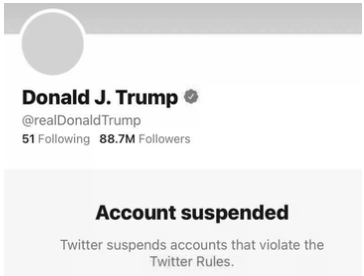
In the wake of Elon Musk’s Twitter takeover, America is left wondering if former President Trump will be allowed to return to the platform. Musk has alluded to this action throughout his negotiations with Twitter, which has Trump anxiously awaiting his grand return to the social media network. Now that the Tesla founder officially owns Twitter, Musk has reportedly fired staff members responsible for suspending Trump, which raises speculation surrounding the issue.
With midterm elections rapidly approaching, reinstating Trump’s Twitter account could have serious ramifications.
It is clear that the former president can mobilize large groups of people by claiming election results are fraudulent. Whether or not these claims are founded upon accurate evidence, Trump’s rhetoric influences large numbers of people to take unprecedented action. His tweets on Jan. 6, 2021, were a major catalyst for the riots on the Capitol that took place.
Trump’s return to Twitter could result in another Jan. 6 scenario. Two consecutive unpeaceful transitions of power after elections would further polarize the nation, making collaboration between parties out of reach.
The former President has been subpoenaed by Congress because of his actions on Jan. 6. Additionally, the subpoena specifically requests electronic communications related to Trump’s actions on that day. No president is above the law, but Trump would certainly use Twitter to convey otherwise. Musk would put members of the select committee in danger if he reinstates Trump’s Twitter account.
Recently, Steve Bannon, a former Trump administration member, has been sentenced to prison time for ignoring a Congressional subpoena. Former President Trump should face the same consequences if he chooses to ignore his subpoena. If Trump is allowed to tweet once again, his previous behavior indicates that he will continue to promote his agenda, even if it puts others in harm’s way.
While many, including Trump himself, argue that banning him from social media is a violation of the First Amendment’s freedom of speech clause, the right does not protect individuals who knowingly scream “fire” in a crowded public space. Metaphorically, this is exactly what the former president has done.
The recent attack on Paul Pelosi, the Speaker of the House’s husband, foreshadows the consequences of social media being used as a catalyst for polarization within American politics. Make no mistake, there is a clear reason why this occurred less than two weeks before the election.
Disagreement and debate are inherent features of any democracy. Attacking the Speaker’s immediate family member and fracturing his skull is not. Ultimately, the Constitution protects only non-violent protest and organization.
Trump’s consistent public shaming of particular politicians that disagree with his viewpoints, including Nancy Pelosi, makes them targets for violence and harassment. Upholding democratic checks and balances as outlined in the Constitution is not justification for violence, even if one disagrees with the course of action.
Donald Trump Jr.’s actions on social media in response are only perpetuating radicalization and political violence. The post, which can be found on Truth Social, is a picture of a hammer and a pair of underwear with the caption “Got my Paul Pelosi Halloween costume ready.” This response is incredibly insensitive given that Pelosi suffered from a fractured skull that required surgery. All acts of political violence should be taken seriously instead of utilized as a comedic opportunity.
By continuing to use social media in a toxic manner, the Trumps consistently prove that they are unwilling to change despite the horrific consequences.
No matter the party affiliation, everyone should hold officials accountable for their actions online by demanding a formal public apology from the Trumps. Ignoring these issues sets a dangerous precedent for future leaders while putting American democracy on an uncertain path. Like any other American that receives a subpoena, the public should expect former President Trump to cooperate with the investigation.
America cannot deliver justice unless all individuals are subject to the law, including those in power.