
Tag: Providence College
PC Community Marches Against Transphobia and Homophobia
by The Cowl Editor on March 28, 2018
News
by Sabrina Guilbeault ’18
News Editor
At approximately 6:00 p.m. on Friday, March 23, close to 200 students gathered outside the front doors of the Slavin Center for a March Against Transphobia and Homophobia at Providence College.
The march was organized by SHEPARD, a student organization and support group for members of the LGBTQ+ community. SHEPARD’s overall mission is to build a safe, welcoming environment within the club and larger PC community. The executive board of the club invited panelists to speak at the end of the march in the Ruane Center for the Humanities, which included Kristine Goodwin, vice president of student affairs, Tiffany Gaffney ’03, assistant dean of students, and Dr. Christopher Arroyo, associate professor of philosophy.
The PC community was invited to the march via an informational email sent by the SHEPARD president. “Please stand with Shepard in solidarity with love and respect,” the email stated. “The purpose of this march is to affirm LGBTQ+ members of the Providence College community and to recognize their experiences of homophobia and transphobia as valid.”
Many assumed that the march was a reaction to the recent bulletin board that was hung in St. Joseph Hall that said, “Marriage, the Way God Intended It,” promoting the Catholic Church’s doctrine on marriage as being between one man and one woman. For more on that story, please refer to the following link: https://www.thecowl.com/featured/bulletin-board-controversy.
Michael Smalanskas ’18, the resident assistant who put the bulletin board up on his floor, stated that he too thought the march was organized in reaction to that said board. “Many have considered my bulletin board homophobic and an act of hate speech,” he said, explaining that to support traditional marriage is in no way to be homophobic. “People are free to protest, but there should be a basic understanding from students and faculty at this college that Catholic beliefs are not hate speech.”
In an email to student leaders including members of the Board Multicultural Student Affairs, Student Congress, and Residence Life, Goodwin acknowledged the bulletin board controversy and said, “I believe we need to treat each other with respect at all times.” She went on to explain that she hopes the community would join her in being open to dialogue so that it can be informed and effective “allies and educators,” and said a way to do that was to walk in solidarity with SHEPARD “promoting unity, affirmation, and inclusion even amidst controversy.”
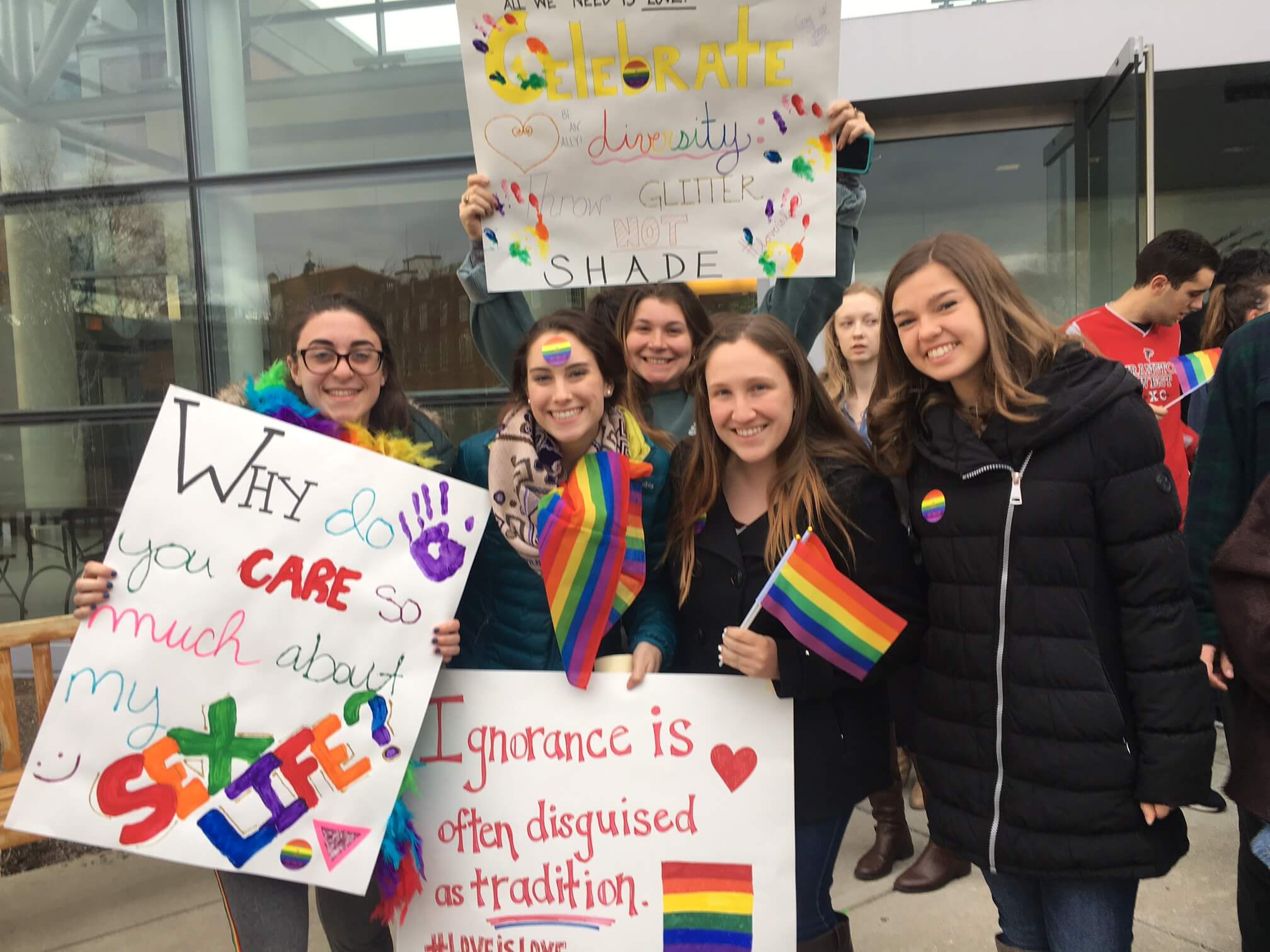
As participants gathered, students distributed rainbow stickers that said, “Hate is Not a PC Value.” Others held signs with messages such as “Love is Love,” “If God Hates Gays Why’d He Make Us So Cute,” “Jesus Had Two Dads and He Turned Out Fine,” and “Ignorance is Often Disguised as Tradition.”

“Do not engage in negative behavior,” said SHEPARD’s president before the march commenced, also explaining that the marchers were not calling for action, but rather standing and marching out of solidarity and love. “Every person deserves equal amounts of respect,” she said. “We are not making demands, we just want to be heard, recognized, and loved.”
From Slavin, the marchers moved towards Raymond Dining Hall by passing McVinney and Moore Hall. From there, they marched around the Smith Quad after passing the Ryan Center, and went though Glay parking lot and up the Guzman stairs before entering into Ruane. All the while, marchers chanted, “Say it loud, say it clear, queer people are welcomed here,” and “Hey, hey, ho, ho, homophobia has got to go.”
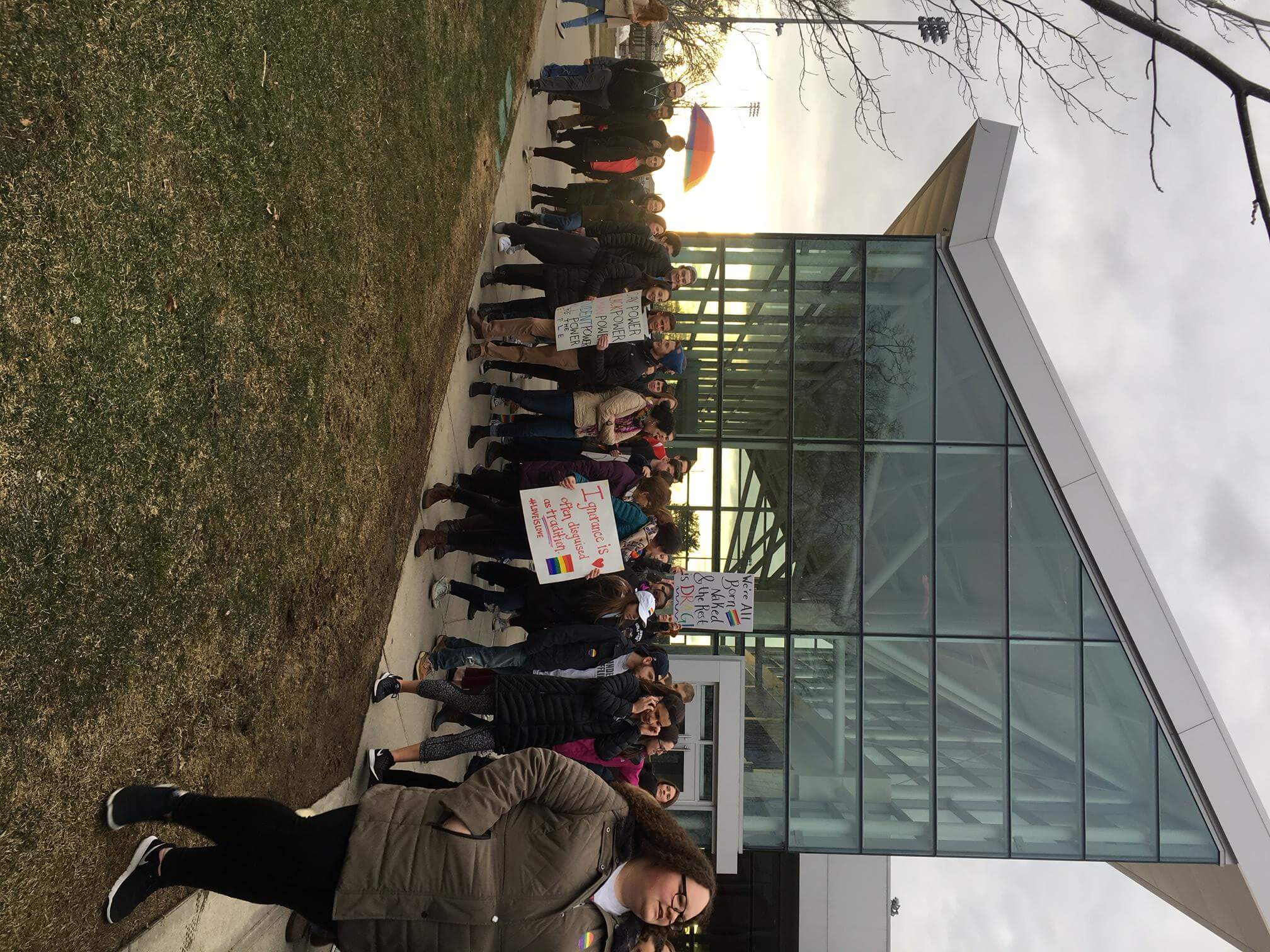
At the conclusion of the march, many students filed into into Ruane 105 where each speaker was given a chance to share and reflect.
After SHEPARD’s president spoke, Goodwin took the podium and emphasized that she welcomes feedback, especially when it is feedback given for the sake of helping others. She also talked about the social work her mother did with transgender individuals and explained that the church she wants to be part of is the kind of church that includes everyone.
Dr. Arroyo acknowledged the SHEPARD executive board for the work they did in organizing the march, and also stated he wished to not misconstrue what was happening at the march. “This is not dismissing Catholic teaching as homophobic, or attempting to stop free speech, or trying to go against Catholic teaching,” he said, explaining that this should not be a two sided argument of Catholics versus the side of the LGBTQ+ community. “Disagreements should not lead us to despair of resolving them.”
After discussing the meaning behind PC’s mission of Veritas, or the truth, he insisted the truth must be used to guide the College in these difficult times. “The spirit of the march is to identify truths,” he said. “Some members in our community identify as LGBTQ+, and they’re students who are equal and full members deserving of respect and love.”
When Dean Gaffney spoke, she acknowledged that though it states very clearly in the College’s policies that it does not discriminate based off of race, gender, or sexuality, the fact of the matter is that not all members of the PC community necessarily live this experience. “Plus, we must be honest with ourselves, when we say we are here for the LGBTQ+ community, we don’t know who they all are, and that is a truth we must acknowledge,” she said.
She then explained that when people are silent, they leave room for assumption. “We are all here for our own personal intentions,” she said. “I am not here because of a bulletin board, I am here because I am unapologetically an ally.”
Dean Gaffney then explained that ally-ship is not to be taken lightly, as it is an “intentional commitment to be there for and with others.” “I am unapologetically Catholic, and it is because of my faith that I am an ally,” she said. “If you think that we’re here just because of a bulletin board, you aren’t paying attention.”
“Some members of the LGBTQ+ community identify as Catholic,” said Dr. Arroyo, who then stated that homophobia and transphobia have no place at a Catholic institution. “We must insist that affirming the equal dignity of all human beings in what we say and what we do affirms our mission of a Catholic college.”
Other speakers included Dr. Jonathan Dator, staff psychologist at the Personal Counseling Center, Cate Latz of the Office of Institutional Advancement, and Kendra Brewster a professor in the public and community service department.
Dr. Bernice A. King Addresses PC Community for Rev. Dr. Martin Luther King, Jr. Convocation
by The Cowl Editor on January 19, 2018
News
King Discusses Nonviolent Protest and Creating the “Beloved Community”
by Ernie Andreoli ’18
News Staff
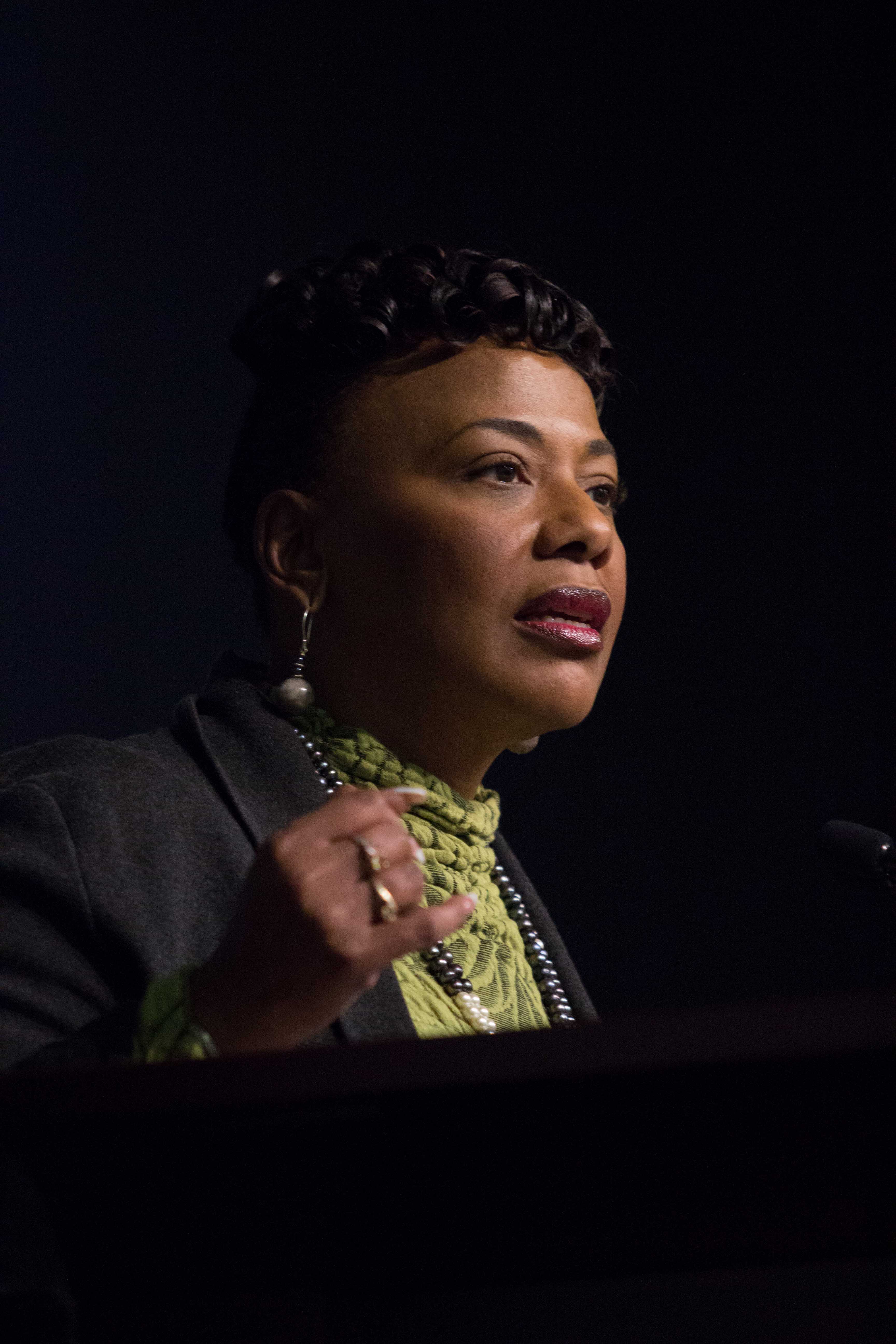
Dr. Bernice A. King, a distinguished minister and the youngest daughter of the late Rev. Dr. Martin Luther King, Jr. and Coretta Scott King, presented the keynote address at the inaugural Rev. Dr. Martin Luther King, Jr. Convocation at Providence College on Thursday, January 18. Over 600 students, faculty, and members of the Providence community packed into the Peterson Recreation Center to hear Dr. King’s lecture on her father’s legacy, as well as the importance of sustained civil rights activism.
In commemoration of the 50th anniversary of her father’s assassination, King stressed that “together we win with love for humanity.” After an introduction by Dr. Hugh F. Lena, provost and senior vice president for academic affairs, Father Brian Shanley, O.P., greeted the crowd by touching upon the late Dr. King’s vision of the “beloved community.” Fr. Shanley reiterated that an interconnected community and a “just social order” could only be accomplished through “faith, hope, and love.” As a part of the MLK Convocation week on campus, Fr. Shanley honored Dr. Francis P. MacKay, Dr. René E. Fortin (posthumous), Dr. Mark N. Rerick (posthumous), and Rev. Robert A. Morris, O.P. (posthumous) for creating the Rev. Dr. Martin Luther King, Jr. Scholarship at Providence College.
Fifty years ago, Rev. Morris, a champion of diversity and inclusion, encouraged the College’s administrators to create a scholarship for incoming students that commemorated the civil rights achievements of the late Rev. Dr. King Jr. During the fall semester of 1968, a cohort of students received this notable award. Today, 100 students have received this scholarship from the inspiring works of these four honorees and their commitment to equality, diversity, and inclusion.
Following the inaugural presentation of the MLK Vision Award, Ralph E. Tavares, director of multicultural student success and assistant dean of undergraduate studies, spoke of the continuous importance of selflessness, dedication, and love throughout our lives and communities. While Tavares acknowledged that polarized political ideologies and instances of hatred have divided the College’s community to a certain extent, he asserted that “love will keep us planted.”
Following Tavares’s remarks, Phionna-Cayola Claude ’18, president of Student Congress, emphasized the “power of conversation” to combat bigotry. Claude contended that while all individuals hold different beliefs, equality and justice are essential for communal development and self-actualization. Prior to introducing Dr. King as the keynote speaker, Claude stated that Dr. King is the living example of her father’s purpose.
In commemoration of her father’s life, Dr. King encouraged all in attendance to perform 50 acts of kindness and service to individuals of another race between now and April 4, the day her father was assassinated in Memphis, in an effort to mitigate the current racial climate. Furthermore, Dr. King invited all attendees to take part in the March for Humanity in Atlanta on April 9 in an attempt to connect with one another, impede racial discrimination, and enact positive change in people and institutions.
According to Dr. King, nonviolent resistance, a practice her father tirelessly encouraged, is the most necessary tactic to be used in social movements, as well as throughout our lives. Specifically, in a time of technological connectedness and social unrest, Dr. King proclaimed that “when it comes to humanity, we cannot have losers.” Ultimately, in order to “create a beloved community,” Dr. King exclaimed that nonviolent resistance will lead to our spiritual and moral development.
Dr. King examined her father’s studies in theology and civil activism, and how these teachings fare in 2018. As her father declared in the mid-1950s, she reiterated that the Montgomery Bus Boycott “was not a victory over white people.” Rather, Dr. King emphasized that the political and social protest was a “victory over injustice.” In order to expose the ugliness of violence and injustice in this day and age, Dr. King encouraged all in attendance to face prejudice through love.
Following Dr. King’s address, Tavares moderated a Q&A session between Dr. King and those in attendance. Adriel Antoine ’18, president of PC’s chapter of the NAACP, asked Dr. King for her thoughts on how to keep the momentum going with current social and political resistance movements. “People are responding, but they are not organizing,” stated Dr. King. While she acknowledged that protests are an important component of nonviolent resistance, Dr. King insisted that “the goal is change.”
Dr. King encouraged all in attendance to make justice, freedom, and righteousness a reality. In January 2012, Dr. King was appointed chief executive officer of The King Center, a nonprofit organization founded by Coretta Scott King in 1968. Located in Atlanta, Georgia, this resource institution is committed to nonviolent social change in honor of the late Rev. Dr. King Jr., Mahatma Gandhi, and Rosa Parks, among other influential social activists. Dr. King graduated from Spelman College with a B.A. in psychology in 1985 and obtained her J.D. and Master of Divinity from Emory University in 1990. Reflecting on the convocation, Jayson Sanderson ‘21 noted “It was breathtaking.” Sanderson went on to state that Dr. King’s lecture provided “a lot of encouragement to people of color, as well as the entire PC Community.”