
Tag: culture
Does 2026 Just Mean 2016?
by Grace Pappadellis ’29 on February 12, 2026
Opinion - Entertainment & Society
I am going to take a trite term and do my best to infuse it with some sort of comfortable nostalgia, but also with the notion that we must stay well-informed, vigilant, and understanding of society at all times. History repeats itself. It is repeating itself.
Sure, the New England Patriots were in the Super Bowl, and whether that was an exciting idea or a completely devastating fact for someone, it is reminiscent of 2016, when the Pats were on top, and New England families, like my own, were ecstatic and proud. Snow has been falling, similar to our childhood holidays, we are embracing fashion from the early 2010s, and young voices are prominent in the way 2016 had a sudden hankering for new types of internet culture and development of aesthetics. On the other hand, society is once again experiencing an increased amount of political polarization, and regardless of your level of privilege or conscious decision to engage or disengage, politics are affecting everyone. Changes that we were facing in 2016 felt monumental, and although a decade has passed and the country has undergone different structural changes, it seems we are in a very similar place—possibly living through the consequences of our previous political choices.
With that being said, although nostalgia is a wonderful feeling, and understanding the political and social state of society does not mean we have to collectively ignore the avenues for joy, we should acknowledge every event, every issue, and every accomplishment. We need to let go of the concept that joy, or political neutrality, rather, and being knowledgeable, empathetic, and proactive around topics we may be removed from, should not be mutually exclusive. To add my own essence of where I stand politically—remaining neutral won’t get us anywhere, and you can be a happy, well-rounded person while staying informed, advocating for those who cannot, and remembering that cutting yourself off from the real news, the real truth, will forever hinder your authentic understanding of the society you, yourself, live in.
2016 marked an enormous political divide. Social media was making a huge impact on society, creating new exposure to opinions, news, and all sorts of nuanced ideas. People were emboldened by such a polarized society, their interest in politics increasing, and although real human involvement is important to support a democracy, the politics circulating harbored heavy partisanship, hate, and a lack of consideration for different people living in this country. Today, in 2026, TikTok has become a main news source for people, in lieu of credible news stations, newspapers, and web articles. When having conversations about current events today, you’re more likely to hear a person, especially a young person, say, “Did you hear about x, y, and z? I saw a TikTok about it,” than referencing a news station. Thirty-second social media clips are accessible, easy to understand, and allow people to neglect their accountability to read and learn about what is really happening in the world. The inability to absorb credible news is leading to ignorance of the parallels between 2016 and 2026.
President Donald Trump built his 2016 campaign on building a wall to keep immigrants out of the country. Today, the Trump administration funds and defends Immigration and Customs Enforcement that actively terrorizes citizens of our country. Repetition is not a comfort when the repetition is detrimental to the livelihood of people living in the country, living in constant fear that they are subject to ICE’s brutal modes of operation. Ignoring these parallels and deeming the state of the country as “not our problem” sets us back not only to 2016, but to eras when voices of marginalized groups were considered invalid and meaningless.
As 2026 rolls on, we must stay keen on learning, so we can have an abundance of knowledge on the state of the country, knowledge that can never be taken away. Consuming credible news and listening to multiple sources makes us more credible people! Since history is repeating itself in many forms, we can appreciate our need to reminisce, but we can also appreciate our obligation to change. We need to plan our future so it can be different from our reality, and we can maneuver through every hardship and indefinite struggle with more intelligence, fortitude, and veracity. More than 2016. Even more than this moment in time.
Bad Bunny’s Halftime Performance: Reactions from the PC Community
by Shannon Kelly ’26 on February 12, 2026
News
On Sunday, Feb. 8, Benito Antonio Martínez Ocasio, colloquially known as Bad Bunny, performed during halftime of the 60th Super Bowl at Levi’s Stadium in Santa Clara, CA. He made history as the first Latin artist to headline the consistently most watched event on television each year in the United States. His performance included guests such as Ricky Martin, Cardi B, Karol G, Jessica Alba, Pedro Pascal, Lady Gaga, and others. For Americans, the Super Bowl halftime show emblematizes the vast social and cultural identities that exist within our country. It is currently estimated that 135 million people watched the halftime performance on Sunday, which was described as a “cultural game changer” in which Bad Bunny “delivered an interactive celebration of Latino culture at one of the most contentious times for the community in the United States.”
The show has garnered praise, controversy, and tension, including on our own campus. Many individuals on this campus utilized YikYak, an anonymous application that allows you to communicate with others in your respective communities, to resort to racist speech and ideology when discussing the halftime performance. For example, many people posted about not understanding the music due to Bad Bunny solely singing in Spanish, wrongly assuming Bad Bunny is an immigrant despite being from Puerto Rico (a U.S. territory), and many made comments sexualizing the dancers. Comments that were made by Providence College students in a group chat include a sarcastic, “I loved all the English” and, “I don’t speak Spanish. I’m not American enough.” Other comments that were made on YikYak include, “Get ICE up and moving around,” “Love me the all inclusive DEI Halftime Show,” and, “English please damn.” This demonstrates the tendency to interpret a performance solely through one’s own cultural identity and a lack of desire to understand both cultural and linguistic experiences that differ from your own. The possibility of YikYak being banned on PC’s wifi is currently being talked about in the Faculty Senate.
Bad Bunny’s performance highlighted many parts of the Puerto Rican experience in terms of politics, sociality, history, and culture. He even said that he sought to “bring what people can always expect from me and a lot of my culture.” Specific examples include demonstrating Puerto Rico’s agricultural roots in the sugarcane fields, casitas where people live, individuals playing dominoes, and a general focus on Puerto Rican resilience, especially in recognition of their colonialist past, which includes involvement from the U.S. After Bad Bunny won his Grammy for Album of the Year, Ricky Martin addressedBad Bunny, saying he had “won without changing the color of your voice. You won without erasing your roots. You won by staying true to Puerto Rico.” Additionally, Bad Bunny’s performance occurred just months after President Donald Trump signed an executive order that declared English as the national language, despite an estimated 42–45 million people speaking Spanish at home in America and a wide array of languages being spoken throughout the U.S.
The President made statements about Bad Bunny’s performance on Truth Social, calling it a “slap in the face to our country,” “an affront to the Greatness of America,” and emphasizing that it “doesn’t represent our standards of Success, Creativity, or Excellence.” Turning Point USA hosted their own “All American Halftime Show,” which was presented as an alternative to watching Bad Bunny. Their halftime show was explained to be “an opportunity for all Americans to enjoy a halftime show with no agenda other than to celebrate faith, family, and freedom.” It is estimated that around six million people watched it, although the official total is under speculation.
An anonymous PC student advised “everyone to rewatch the performance and really sit down with yourself” in order to “empathize that we are not against each other but against the system that is bringing us down.” Bad Bunny powerfully ended his performance by saying, “God Bless America” and listing countries from South America, Central America, North America, and the Caribbean. Behind him stood a billboard that read, “The only thing more powerful than hate is love,” which is a necessary reminder both on this campus and in our world as a whole.
Why Fanfiction Matters
by Meghan Mitchell '23 on April 20, 2023
Opinion Staff
Opinion
Fanfiction is a strange topic. When mentioning it, you’re bound to be met with a wide range of reactions, from “You write fanfiction too?” to “You mean that nerdy fiction that tweens write?” As someone who has been in the fanfiction community for quite a while, I have seen my fair share of both well-written stories with in-depth characters and vivid world-building… and fiction that reads like it was written by twelve-year-olds who forgot spell check exists. Regardless, even the worst writers improve as they age, honing their writing skills and eventually creating something worth hyper-fixating on. However, despite the harmless fun of writing about characters of certain fandoms, many people still disregard fanfiction as a childish hobby. What these people fail to realize is that fanfiction does matter, for a variety of reasons.
The first is fan interaction. It seems like certain fandoms such as Harry Potter, Supernatural, and even Twilight just won’t die despite their stories concluding years ago. That is mainly due to the number of dedicated fans still writing and reading about these characters. While the stories aren’t written by the authors of the original source material, fan interpretations can either be a refreshing look at a character or be so similar to the author’s work that it’s hard to tell the difference. Just because the main story is over doesn’t mean it has to stop for readers. In addition, fanfiction can be used as a creative outlet and allow people to become better writers.
Writing can also be therapeutic. Sometimes people will write a character with whom they feel a connection in a situation similar to one that they are currently experiencing, to better cope with the event. This is an example of what someone would call a comfort character. As strange as it may sound, doing this can be a real benefit to people as it helps them feel less alone in whatever situation they are facing.
The last issue is the judgment fanfiction writers face. Fanfiction writers get called childish or face mocking because of the stereotype of it being something only tween girls do. To this, I ask: why do people care so much about what someone does in their free time? There are worse things people can do than writing stories about fictional characters. It’s also not like fanfiction is anything new; some classic literary works we read in Civ, such as Dante’s Inferno, could be considered fanfiction. It keeps people creative, and some of the best storytellers of the modern era got their start by writing fanfiction. It allows people to connect and form bonds in ways they wouldn’t be able to normally. It’s an experience unlike any other, and instead of being scorned, it should be encouraged to allow people to dream and be creative with the characters they love.
The Great Audiobook Debate
by Samantha Dietel '23 on February 16, 2023
Opinion Staff
Opinion
Stop Asking Whether It Counts as Reading
There is no greater debate in the book world than whether audiobooks count as reading. Avid readers will argue that listening to a book while busy doing other things cannot compare to sitting down and holding a book in your hands. Many people view listening to a book as cheating—a fake accomplishment. Others find that audiobooks are a great way to stay caught up with your reading goals if you are dealing with a busy schedule and are always on the go. Additionally, there’s the added benefit of choosing the speed you want the book to be. If you’re looking to keep up your reading goals while making the most of your time, an audiobook sounds perfect. However, if your goal is to optimize retention and learn the material of a book, listening to the text may not be the best path.
Numerous psychological studies have been conducted on the format in which books are presented and what relationship this has with our comprehension and retention of the material. Based on their results, it would seem that the old-fashioned physical copy of a book is the best way to read. When reading, research has found that 10 to 15 percent of eye movement is spent rereading what we have already read. This process of rereading happens so quickly that we don’t even realize we’re doing it. However, it can significantly increase our comprehension of the text—far more than listening to the text read aloud to us.
Further, as college students, we are all busy and often try to manage multiple activities at once. It is for this reason that an audiobook may seem so appealing. However, with this busy schedule, it is not uncommon for our minds to wander as we read. This occurs no matter the book’s format. However, with a physical book, it is much easier to find the place where you lost your train of thought. You might still be on the same page or even paragraph. With an audiobook, however, it is more difficult to find where you drifted from the text as the speaker kept going, whether you were paying attention or not.
The distinction between reading formats may be most important when reading for class. If you know that the material being covered in the book is important to comprehend, you need to consider which format will help you learn best. A study from 2010 showed that students who read a lesson on paper performed significantly better on a comprehension quiz than students who listened to a podcast of the same lesson. This continues to support the idea that having the text in front of you and going through the physical process of reading is the best way to retain what you have read.
However, the need to retain the material depends entirely on your purpose for reading the text in the first place. If the reading covers particularly challenging concepts for school or work, this may impact which format you decide to choose. If you’re reading a lighter and easier novel for fun, the difference in comprehension may not matter. If anything, you may prefer the audiobook style that lets you enjoy reading during the semester while still accomplishing your other daily goals. It can seem impossible to keep up with reading during the semester if you need to carve out time in your schedule to sit and focus on nothing but the physical book in your hand. Additionally, audiobooks can be cheaper than buying new books from a bookstore while also avoiding the hassle of having to wait for a book to come in or facing the possibility that the store you visit doesn’t have what you are looking for. With audiobooks, you can begin reading them immediately, with access to nearly any text you could want.
Whichever format you choose, you are still reading the material. It is ableist to deny that an audiobook counts as reading. Disability drives innovation—finding new and creative ways to accommodate disabilities has been beneficial to the entire population. Looking at the history of books, audio technology allowed a world of people to enjoy something that was initially invented to help a smaller population have the same opportunities to engage with literature. So, yes—audiobooks do count as reading. This is not something that can be argued. What can be debated is which reading format will best suit your needs and give you your desired outcome, which depends entirely on your purpose for reading.
Delicious Dishes from Around the World: PC Cultural Clubs Celebrate Diversity
by The Cowl Editor on December 6, 2018
News
by Kyle Burgess ’21
News Staff
In keeping with a week full of themed cuisine nights sponsored by Providence College’s numerous student-run cultural clubs, Friartown’s Circolo Italiano brought the flavors of the Bel Paese to McPhail’s this past Tuesday. Students had a wide array of traditional Italian dishes to choose from, such as chicken and eggplant parmesan, gnocchi, penne and broccoli, and desserts like cannolis and cheesecake.
Mangia Night continues to be a fan-favorite of students at PC as it has been for the past eight years. “What first inspired it was the traditional Sunday dinner which a lot of Italians do at home,” explained Felicia Lopez ’19, vice president of the club. “We wanted a way to bring our Friar Family and Italian culture together, hence why we invented Mangia as a means of keeping this tradition alive here on campus.”
Il Circolo also has several functions in the works to continue sharing and showcasing their Italian heritage with the student body. On Thursday, December 6, for example, the club plans to collaborate with the College’s Italian department to host a day of celebration of Italian heritage in Sullivan 212.
Additionally, the club hopes to ring in St. Joseph’s Day with zeppoles and other Italian pastries this coming March, along with a wine tasting event next semester for those 21 and older.
Alongside PC’s Italian club, other student organizations such as Campus Ministry, the Gaelic Society in partnership with Students Obtaining the Meaning of Spanish (SOMOS), and the Board of Multicultural Student Affairs (BMSA) also held food-related events this past week.
Campus Ministry held a beignet run on Thursday, November 29 that helped raise funds for their upcoming NOLA immersion trip in 2019. This trip allows students to take part in working alongside the New Orleans community that is still recovering from the devastation of Hurricane Katrina.
BMSA hosted Cheesefest in ’64 Hall on Monday, November 26, to share cheese-themed dishes from around the world with the student body. BMSA holds this event every year, making it a fun-filled and delicious event the PC student body always looks forward to.
“Cheesefest is an annual opportunity for PC to come together to celebrate the glory of cheese as well as eleborate culture and explore the tradition of food in various cultures and places around the world,” Hannah Mackie ’19, vice president of BMSA.
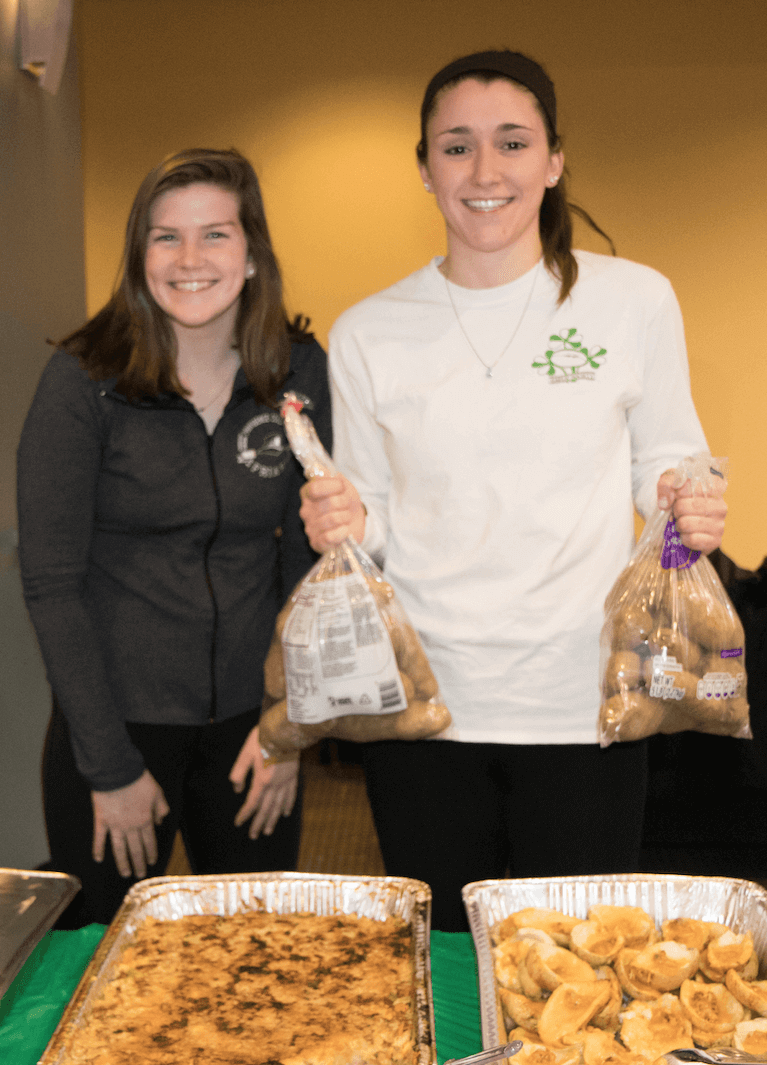
Other on-campus events included a potato mash co-sponsored by PC’s Gaelic Society and SOMOS, which showcased traditional dishes of Irish and hispanic cultures. “We really loved the opportunity to co-sponsor with SOMOS because there are so many fantastic cultures represented on this campus and BMSA gives us a chance to show them to the greater PC community,” explained Camille Greaney ’19, vice president of Gaelic Society. “I have always found that sharing food is a great way to come together and what better food to share than potatoes!”
With the semester coming to a close and finals just around the corner, these clubs have helped students take a break from the workload to enjoy some good food and learn more about the cultures at PC.
Delicious Dishes from Around the World: PC Cultural Clubs Celebrate Diversity
by The Cowl Editor on December 6, 2018
News
by Kyle Burgess ’21
News Staff
In keeping with a week full of themed cuisine nights sponsored by Providence College’s numerous student-run cultural clubs, Friartown’s Circolo Italiano brought the flavors of the Bel Paese to McPhail’s this past Tuesday. Students had a wide array of traditional Italian dishes to choose from, such as chicken and eggplant parmesan, gnocchi, penne and broccoli, and desserts like cannolis and cheesecake.
Mangia Night continues to be a fan-favorite of students at PC as it has been for the past eight years. “What first inspired it was the traditional Sunday dinner which a lot of Italians do at home,” explained Felicia Lopez ’19, vice president of the club. “We wanted a way to bring our Friar Family and Italian culture together, hence why we invented Mangia as a means of keeping this tradition alive here on campus.”
Il Circolo also has several functions in the works to continue sharing and showcasing their Italian heritage with the student body. On Thursday, December 6, for example, the club plans to collaborate with the College’s Italian department to host a day of celebration of Italian heritage in Sullivan 212.
Additionally, the club hopes to ring in St. Joseph’s Day with zeppoles and other Italian pastries this coming March, along with a wine tasting event next semester for those 21 and older.
Alongside PC’s Italian club, other student organizations such as Campus Ministry, the Gaelic Society in partnership with Students Obtaining the Meaning of Spanish (SOMOS), and the Board of Multicultural Student Affairs (BMSA) also held food-related events this past week.
Campus Ministry held a beignet run on Thursday, November 29 that helped raise funds for their upcoming NOLA immersion trip in 2019. This trip allows students to take part in working alongside the New Orleans community that is still recovering from the devastation of Hurricane Katrina.
BMSA hosted Cheesefest in ’64 Hall on Monday, November 26, to share cheese-themed dishes from around the world with the student body. BMSA holds this event every year, making it a fun-filled and delicious event the PC student body always looks forward to.
“Cheesefest is an annual opportunity for PC to come together to celebrate the glory of cheese as well as eleborate culture and explore the tradition of food in various cultures and places around the world,” Hannah Mackie ’19, vice president of BMSA.
Other on-campus events included a potato mash co-sponsored by PC’s Gaelic Society and SOMOS, which showcased traditional dishes of Irish and hispanic cultures. “We really loved the opportunity to co-sponsor with SOMOS because there are so many fantastic cultures represented on this campus and BMSA gives us a chance to show them to the greater PC community,” explained Camille Greaney ’19, vice president of Gaelic Society. “I have always found that sharing food is a great way to come together and what better food to share than potatoes!”
With the semester coming to a close and finals just around the corner, these clubs have helped students take a break from the workload to enjoy some good food and learn more about the cultures at PC.