
Tag: anniversary
Hannahversary: The 20th Anniversary of Hannah Montana
by Isabelle Camoin ’26 on April 16, 2026
A&E - Film & TV
The 20th anniversary of Hannah Montana was a celebrated television event that premiered on Disney+ and Hulu on March 24. My mom had mentioned that the special was going to be aired, as she knows how much I enjoyed watching Hannah Montana growing up. I did not know what to expect from an anniversary special of a show that is no longer being filmed, but I decided I might as well check it out.
The Hannah Montana 20th Anniversary Special featured an exclusive interview hosted by Alex Cooper, the host of Call Her Daddy podcast. During the special, Miley Cyrus takes credit for the special taking place, claiming it was her idea and not Disney’s. She simply announced on social media that the special was happening, which accumulated so much fan support there was no choice but to put on the show. This really draws our attention to how powerful popularity can be and how publicity can lead to action.
In a way, this method of garnering support is pretty on brand for Hannah Montana itself. The show depicted a once-fictitious audience, featuring staged performances with paid crowd actors who were supporting a fictitious pop star named Hannah Montana. Unlike a Seinfeld episode where Jerry featured clips from his live standup to introduce a fictitious show, Hannah Montana’s performances in the TV show were entirely fictional. This fictitious character now has real fans and real supporters. Eventually, there was a Hannah Montana tour, where Cyrus toured as Hannah Montana, singing the songs written for the show. Cyrus reminisces on these performances during the anniversary sharing, “It was me,” reclaiming her work and merging her private and public identity into one.
As I was watching, I found it peculiar that a fictional character became so real. Where else in life does this phenomenon happen? Cyrus also performed some of her so-called “Hannah” songs in order to depict her journey of reclaiming her now unified identity. She performed “This is the Life,” a Hannah Montana song that was performed during her time as an adolescent. In her attempt to reclaim her identity through performance, Cyrus performed this song in a more mature manner, in an elegant gown, with a single spotlight, less glitter, a slower tempo, and with a much deeper voice, signifying that the artist she once performed as no longer exists.
The special itself depicted Cyrus embracing her alter ego Hannah Montana, sort of like how Taylor Swift re-released albums to sell her versions. In fact, she even took credit for launching the career of Swift by giving her a platform in Hannah Montana: The Movie (2009). Throughout the special, Cyrus took credit for many things related to pop culture, including contemporary culture as it exists today. During her short time on air and reminiscing about their acting together, Selena Gomez remarked, “You created culture babe.”
The interview took place on the set of the show, and the audience was given a tour of Hannah Montana’s closet. This was a staple location during the filming of Hannah Montana; it was the place where the transitions happened. Cyrus would step into the closet and come out as her alter ego, pop star Hannah Montana. Throughout the special, Cyrus met with key people in her life. Each time passing on objects from the closet, signifying that she was letting go of the Hannah identity tied to the Disney show.
As I watched, I kept experiencing this cycle of beginning to feel emotional about the picture Cyrus was painting, but these moments were continually interrupted by advertisements. The special in its entirety was about an hour and a half, though about 30-minutes of it consisted of ads.
Not to mention, despite this overarching theme of identity and reality, Cooper seemed to barely scratch the surface. I thought this special was really going to get somewhere when it came to better understanding Cyrus and her relationship with Disney. To a degree, she reflected on how the show and the network shaped her development, especially by working with her dad on set as her on-screen father. However, Cooper was more concerned with asking about her outfits, her appearance, and her crushes than asking interesting, hard-hitting questions.
Writer’s Opinion: I find it hard to enjoy a sentimental TV special of this sort, and the drama of which Sprouse twin Cyrus was most attracted to at the age of 14, when the United States is currently facilitating the destruction of another country’s civilization.
I am not saying I expected Cyrus to be political by any means, but I expected this special to be a bit more meaningful rather than subliminal. Additionally, I think this special really draws our attention to how some art and pop culture chooses and are so far removed from our general society. I consumed this special without having to bat an eye at any deep retrospection of myself or the world around me. Which got me thinking: we are so worried about iPad kids, but it is our generation that was raised on pop culture and the external influence of curated fiction that is mass-produced and consumed.
Celebrating 90 Years: The Importance of Student-Run Journalism
by Kaelynd Brouillette ’29 on November 20, 2025
Opinion
On Nov. 16, 1935, the very first edition of the Providence College newspaper we all know and love, The Cowl, was published. As I reflect on the 90th anniversary of The Cowl, I have come to recognize how remarkable it is for a student-run newspaper to survive and thrive for nine decades. I believe that student-run newspapers are incredibly important to college campuses, as they act as living timelines of an institution’s political, cultural, and social evolution. The Cowl’s monumental milestone is not just an anniversary for Providence College, but also a reminder of the enduring role student-led journalism plays across campuses nationwide. Student newspapers do matter. Across the country, campus publications serve as watchdogs, historians, and cultural critics all at once. At various schools and higher education institutions across the country, student reporters have exposed financial mismanagement, challenged administrative decisions, and brought national attention to issues that otherwise might have been ignored. These papers, including The Cowl, show that student journalism is often seen as one of the most active democratic institutions a campus has.
In an era where universities so carefully manage their public identities, college newspapers remain an example of the few places where open dissent can still be aired for the public. For example, in The Cowl edition published on April 25, 2024, a collective of students, staff, alumni, and faculty wrote an article directed towards Father Sicard O.P. ’78, ’82G, calling out hypocrisy and systematic oppression towards members of the LGBTQ+ community on campus. Anonymous letters to the editor, such as the one mentioned above, allow for members of our college community to express concerns and critique campus culture in ways official university messaging never could. Student newspapers remain mostly independent from administration, giving them the power to report on issues that could otherwise remain buried in bureaucracy, such as violations of student rights, system-wide oppression as mentioned above, Title IX mishandlings, and failures in mental health services. In fact, The Cowl reported on almost all of the aforementioned issues here at PC. University newspapers can also be a training ground for civic engagement, as student journalism teaches investigation, healthy skepticism, fact-checking, and public communication, which are all foundations of a functioning democratic campus and nation. Many major journalists, politicians, and public thinkers started their careers in college newspapers, learning the responsibility of correctly informing a community and gaining experience in cultivating political awareness. Even for students who do not have any prior journalism experience, such as myself, participation in a student-run newspaper can cultivate a deeper understanding of how institutions work, as well as many important skills, such as research, writing, and critical thinking, that will benefit them in all aspects of life. Ultimately, the role of student newspapers goes far beyond reporting news, as they preserve the integrity of campus life by ensuring truth, accountability, and that student voices never disappear behind the walls of institutions.
Yet, while student newspapers play a critical role, their existence is far from assured. Student publications face mounting challenges that threaten the very work they do, including budget cuts, the rise of digital media, and censorship by administration. For example, the Indiana University student newspaper, the Indiana Daily Student, is facing challenges from its administration that led to its staff advisor being fired for refusing his superior’s request to censor the paper. The University also attempted to cancel the physical printing of the paper, sparking a First Amendment lawsuit against the University. The increasing pressure from university administrations, who sometimes attempt to limit key reporting or show control over publishing decisions, as well as many other struggles college newspapers face, has made it progressively more difficult to operate with the influence they once had. Despite these pressures, student journalists continue to do the work anyway, often unpaid, unrecognized, and at odds with institutional comfort. College newspapers persist not because it is easy, but because students believe their campus deserves honesty, reflection, and important discourse to raise awareness about issues and create a necessary change. The fact that The Cowl has endured for 90 years is a testament to PC’s history, but also to the countless students who refused to let the publication fade, even in moments when support was limited or interest waned.
So, as we celebrate this important Cowl milestone, it is worth imagining where The Cowl might be 90 years from now. Perhaps it will exist entirely in digital form, with the words of students never reaching paper, or maybe the demand for print will continue, and maybe even grow. Perhaps journalism will look entirely different than how it does now, shaped by technologies we have not even conceived yet. Nonetheless, if The Cowl retains the spirit that has carried it through nearly a century, the idea that students deserve a platform that is truly their own, then its future will remain hopeful, even in an uncertain media landscape. And perhaps, that is the real legacy of student journalism: despite the challenges, despite the shifts and pressures, it endures, because students insist on telling the truth about the place they call home.
The Cowl Celebrates 90 Years
by Olivia Gleason '26 and Sarah McCall '26 on November 20, 2025
News
With Insights from its First Female EIC
Sunday, Nov. 16 marked 90 years of Providence College’s student-run newspaper, The Cowl. Since 1935, students have come together to provide campus, local, and global news to the PC community. The Cowl plays an integral part in understanding the College’s history as it has documented important milestones and events ranging from the opening of the Ben Mondor Center for Nursing and Health Sciences, to the admission of women at PC, to coverage of the Friars’ football team. While social media and the internet have drastically altered the way college students consume news and media, The Cowl has remained a fundamental part of campus life. Whether it be through submissions of Letters to the Editor, picking up a copy of the most recent edition at any corner of campus, or even posts related to the newspaper on YikYak, the PC community still sees The Cowl’s impact and purpose as it strives to provide a platform for student voices and a space for its members to delve into the dynamic world of journalism.
As we reflected on The Cowl’s history in preparation for this week’s anniversary edition, we knew that the discussion of its history and significance would be greatly enriched by insights from its first-ever female editor-in-chief, Kendra Bogosian-Marasco ’87. Currently a Title IX advocate and formerly the director of field education at PC, Bogosian-Marasco made Cowl history in the ’86–’87 academic year when she challenged the status quo of the male-dominated publication to become its leader. Her experience in this position provides a glimpse into both how The Cowl has changed and, in many ways, how it has stayed the same in its general mission. We asked Bogosian-Marasco what it was like to come onto the scene as The Cowl’s first female EIC, to which she revealed that it “was the first time in my life that I experienced what being a woman in our society (at the time) meant in an institution that had only had women as part of its student community for 25 years.” Bogosian-Marasco had to jump hurdles of past social norms at the College, including having to “go through multiple ‘interviews’ with administrators” that her predecessors—male EICs—did not. Her perseverance, despite pushback and doubt, allowed her to pave the way for future women of The Cowl, forever changing its power and richness. To get a sense of what marked her time at The Cowl—and to also highlight historic moments for both the publication and PC—we asked Bogosian-Marasco if there was a pivotal moment that stood out to her during her tenure as EIC. Without hesitation, Bogosian-Marasco said, “This is an easy one. . . I was editor-in-chief for the 1986–1987 academic year. Our basketball team had a tremendous season that year and went to the Final Four; Billy Donovan ’87 became a household name.”
Coverage of such success for Friars basketball was undoubtedly thrilling for The Cowl. Its documentation of this historic season continues to serve as a reminder of the power student journalism has to define the collective memory of the College, and the great responsibility the publication carries as the storyteller of such monumental moments.
As we have all seen, technology has altered the way we interact with both the world and media. The same is true in media and news production. Our writing, editing, and publishing practices now are much different than they were throughout The Cowl’s history. For example, Bogosian-Marasco reflected on a major technological advancement during her career with The Cowl: “During my four-year involvement with The Cowl, we acquired word processors and were thrilled to be able to electronically type our articles. They’d be printed out, pasted onto mark-up boards for layout, and then we’d take those layouts off-site (to a local newspaper in Warwick) to be printed.” This 90-year anniversary calls for the recognition of all of the changes and people who have made The Cowl what it is today. It is not just the late nights on Wednesdays or the tireless work by the editorial board that keep The Cowl running. It is also 90 years of adaptation to keep up with technological advancements and a rapidly changing world.
In many ways, the archives of The Cowl serve as a collective PC time capsule, providing direct insight into student voices of the past and their reactions to the defining moments of their time. This history, however, is more often than not overshadowed, simply by the nature of the fact that our newspaper has stayed true to its original mission of covering current events. As such, for this 90th anniversary edition of The Cowl, we have decided to feature pieces of past editions (as well as publish our usual articles covering issues of today) to give glimpses into this history and to commemorate the work of every member of The Cowl, both past and present, that has shaped our student publication into what it is today. We hope you enjoy this step back in time as we seek to uphold the strong legacy of The Cowl. As Bogosian-Marasco told us, “Please continue to write—and to consume—newspapers throughout your lives. Never compromise integrity in your coverage and always seek out Veritas,” and it is our hope that this issue, and every issue after, does just that.
Edelweiss at 60: Celebrating The Sound of Music
by Isabelle Camoin ’26 on November 20, 2025
A&E - Film & TV
I have been eagerly anticipating writing this article celebrating the 60th anniversary of the iconic film, The Sound of Music (1965). The movie, which was released in the United States on March 2, 1965, was re-released in U.S. theaters Sept. 12–17, celebrating 60 years of the film and reviving its beauty in 4K.
The film stars Julie Andrews as Maria and Christopher Plummer as Captain Georg von Trapp. Maria, a young nun at Nonberg Abbey, is filled with childlike wonder and spirit in a way that lacks the discipline the Abbey runs on. She is sent by Mother Abbess to be the governess for the seven children of retired naval officer, Captain von Trapp. The family is notoriously known for vanquishing governesses in attempts to seek attention from their cold, removed father. In the film, Maria, once arriving at the von Trapp residence, is at tense odds with Capt. von Trapp when she tries to introduce play and music into the children’s lives. Capt. von Trapp’s heart opens to his children and Maria when he bears witness to their musical gift, bringing joy and meaning back into the family’s lives. All while this is taking place, Nazi Germany is on the rise, and the annexation of Austria is a pervasive threat. The film depicts tensions between love of homeland amidst the rise of power. As Maria makes decisions guided by God’s will, she is confronted with a choice between her religious calling to experience the love of God as a nun and finding God’s love in family. We see these tensions face resolution when Maria and Capt. von Trapp decide to marry and leave Austria before facing the consequences of their resistance to the Nazi regime.
Performing at the Salzburg Music Festival in the last 20 minutes of the film, the von Trapp Family singers take to the stage, performing a moving final farewell to Austria. Concluding the performance with “Edelweiss,” a song composed for the musical, Capt. von Trapp bids his country farewell in a patriotic ode to its beauty.
The film was based on the musical Rodgers and Hammerstein’s The Sound of Music, which was a fictional adaptation of the 1949 memoir, The Story of the von Trapp Singers, written by Maria Augusta von Trapp. The film is a dramatized version of the story of the formation of the von Trapp family. In the film, Maria von Trapp is depicted as a woman who restores love, meaning, and music back into the lives of widowed Georg von Trapp and his seven children. The film condenses the timeline of the family’s departure and rejection of the rise of the Nazi Party in Germany. The plot depicts an escape from Austria, meticulously planned through their performance at the Salzburg Music Festival, where the family of seven children, Maria von Trapp, and Georg von Trapp, flee to the Swiss Alps on foot to reject Georg von Trapp’s invitation to lead the Navy for the Nazi army.
In reality, as written in Maria von Trapp’s memoir, the events occurred over a period of two years. The family performed at the Salzburg Music Festival in 1936 and left Austria by train to Italy in 1938, making their way to the U.S. on a performance tour. They traveled with their priest, Reverend Franz Wasner, as a family of nine with one on the way. Georg von Trapp refused to fly the Nazi flag on their property during the annexation of Austria in 1938, and additionally rejected Naval Command and the request to sing at Hitler’s Birthday party.
The film details Maria von Trapp’s call to the von Trapp family to take care of the children because Georg von Trapp was emotionally unavailable to tend to them and was constantly away on business trips. Accounts in Maria von Trapp’s memoir depict that Georg von Trapp was much more gentle and kind-hearted from the start of her time with the family, and that originally she was brought to the family from The Abbey to take care of and tutor young Maria von Trapp, who had scarlet fever. This is when she began to engage with the already musically talented family, teaching the family to sing madrigals. Georg von Trapp fell in love with Maria von Trapp and asked her to marry him and become a second mother to his children. Maria von Trapp agreed to marry because she was in love with the children and liked Georg von Trapp, eventually coming to love him as well. In the movie, the love between Georg von Trapp and Maria von Trapp is accentuated in a way that differs from this account of Maria von Trapp’s experience. However, in both real life and the movie, Maria von Trapp was confronted with abandoning her religious calling of becoming a nun, but was advised “to do God’s will and marry Georg von Trapp.”
After 60 years, though distorted from the true story, the film is still worthy of celebrating. The film’s recognition by five Academy Awards, Golden Globe Awards, and selection by the Library of Congress as a film to preserve in the National Film Registry reinforces the value of celebrating the film’s timeless themes of love and strength in the arts and in faith. Upon its release, the film received a lot of criticism for being too artificial and corny, and many Austrians did not give the film the time of day. Even though the film dramatizes and romanticizes the depiction of Maria Augusta von Trapp’s involvement with the family, I enjoy the film’s production and composition. Andrews brings to life a playful spirit through music and meaningful engagement.
Milestone Moment for PC Landmark: St. Dom’s Celebrates 20-Year Anniversary
by The Cowl Editor on February 11, 2021
News
by Kyle Burgess ’21
News Co-Editor
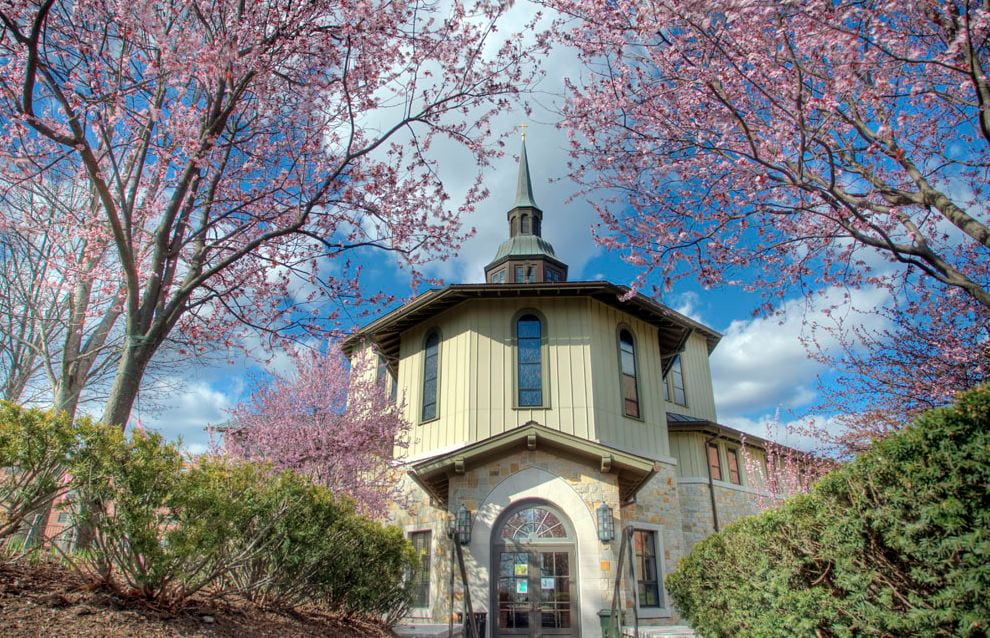
Providence College President Father Kenneth Sicard, O.P., celebrated a special Mass on Feb. 2 as one of PC’s most iconic landmarks celebrated its 20th anniversary. St. Dominic Chapel, more commonly referred to as St. Dom’s by members of the PC community, has quickly become ingrained in the college experiences of many PC students since being erected in 2001. Over the years, the chapel has hosted many milestone occasions and other events, from the popular “Last Chance Masses” on Sunday nights and subsequent post-Mass bash socials, to senior ring blessings, and even confirmations and weddings for alumni.
St. Dom’s also serves as headquarters for the many social and spiritual activities that Friars partake in during their time on campus. Programs such as Habitat for Humanity and Faithworks allow students to become involved in serving the local Providence community. Other programs such as Campus Ministry’s many student retreats are unique opportunities for classmates to connect with one another about their college experiences while also strengthening their Catholic faith together.
“Campus Ministry allows students to grow in faith and work toward building the Beloved Community here at PC,” explained Cam McCauley ’21. “It’s a continuing and collaborative process.” McCauley currently serves as the president of Campus Ministry, having first been introduced to the organization during her freshman year through Habitat for Humanity. She went on to join the club in a leadership role as an English as a second language student minister during her junior year, combining her Spanish major and passion for her faith to help serve others.
McCauley considers this ability to give back to the PC community and Providence community at large as the most rewarding aspect of joining Campus Ministry. “I’m very grateful for the Camp Min community and the experiences I’ve shared with them, but the most rewarding part has been serving others in the community and around campus. I love collaborating with other clubs and meeting new students as well as offering opportunities that serve our brothers and sisters in the community.”
She is also thankful for St. Dom’s Chapel, as it has served as an important resource to her during her spiritual journey at PC. “My favorite memories at St. Dom’s include 10 [p.m.] Mass and Adoration over the years,” said McCauley. “I’ve had a lot of special moments at Mass and Adoration and am very grateful to have the chapel as a safe place on campus.”
Other members of Campus Ministry share McCauley’s appreciation for both the faith community that calls St. Dom’s home and the opportunity to serve others. Father Peter Martyr Yungwirth, O.P., first arrived at PC in January 2015 before becoming the school’s head chaplain and director of Campus Ministry a year later. “As the chaplain, I oversee the liturgical life of the campus as well as work on a number of different committees, many of which are with Student Affairs,” he explained. “There is always a chaplain on-call, 24/7/365. So along with the associate and assistant chaplains, we always make sure to have someone available in case of an emergency.”
Additionally, Fr. Yungwirth oversees both the Campus Ministry staff and Campus Ministry Leadership in the various things that they do, including Peer Ministry, retreats, local and global service, faith formation, and worship. “It’s a blessing to work with so many amazing staff and student leaders,” he added.
Similar to McCauley, Fr. Yungwirth has taken great pride in helping others both in building their faith and their relationships with one another. “The most rewarding aspect of being a part of Camp Min is the connection to a community, both divine and human. Camp Min offers so many opportunities to grow in friends and communion with God, and that’s its ultimate goal. At the same time, often we are drawn to God by others, and so the community of friends that we establish on Earth has a dignity and importance that finds its own purpose in building up that communion between all of us and God.”
For Fr. Yungwirth, St. Dom’s is a place where students can further strengthen the bonds between each other and with God. “I’ve loved being able to sit with students in different meetings or in the confessional and help them to see how the Lord is speaking to them in their lives. It’s such a blessing to see God’s grace actively at work in so many students,” he stated.
For those hoping to get involved with Campus Ministry this semester, be sure to look out for their table at the Involvement Fair on Saturday, Feb. 13. Campus Ministry will also be hosting a variety of different events around Mardi Gras, Ash Wednesday, and St. Patrick’s Day; a memorial wall for those who died of COVID-19; a week to remember persecuted Christians in Iraq; and the Rite of Christian Initiation of Adults Mass on Sunday, April 25.